It's March 3rd. Laura's spring camp signup email is scheduled to go out at 8 AM tomorrow to four hundred and twelve parents she's built up over three seasons. It's 10:47 PM now. She's trying to rename the "Junior Tour Prep" page on her free Wix site from last year's title to this year's, and the header still says 2024 because the header is a separate block she can't find the edit panel for. Her coffee has been cold for an hour. She has three browser tabs open — the Wix help forum, a YouTube tutorial from 2022, and her actual email draft with the button linking to the not-yet-renamed page. She's not going to finish. Tomorrow morning, four hundred parents are going to click a button that takes them to a page that says 2024. She already knows.
That moment isn't a free-website problem. It's a "Laura is the only person responsible for the website" problem. The free part is what made the math feel like it worked when she signed up. The free part is also why the URL still says lauragolf.wixsite.com and why the page still says 2024 at 10:47 on a Tuesday night.
This is about whether free is actually free for a working golf coach. Spoiler: depends.
What "free" actually means in 2026 for a golf coach website
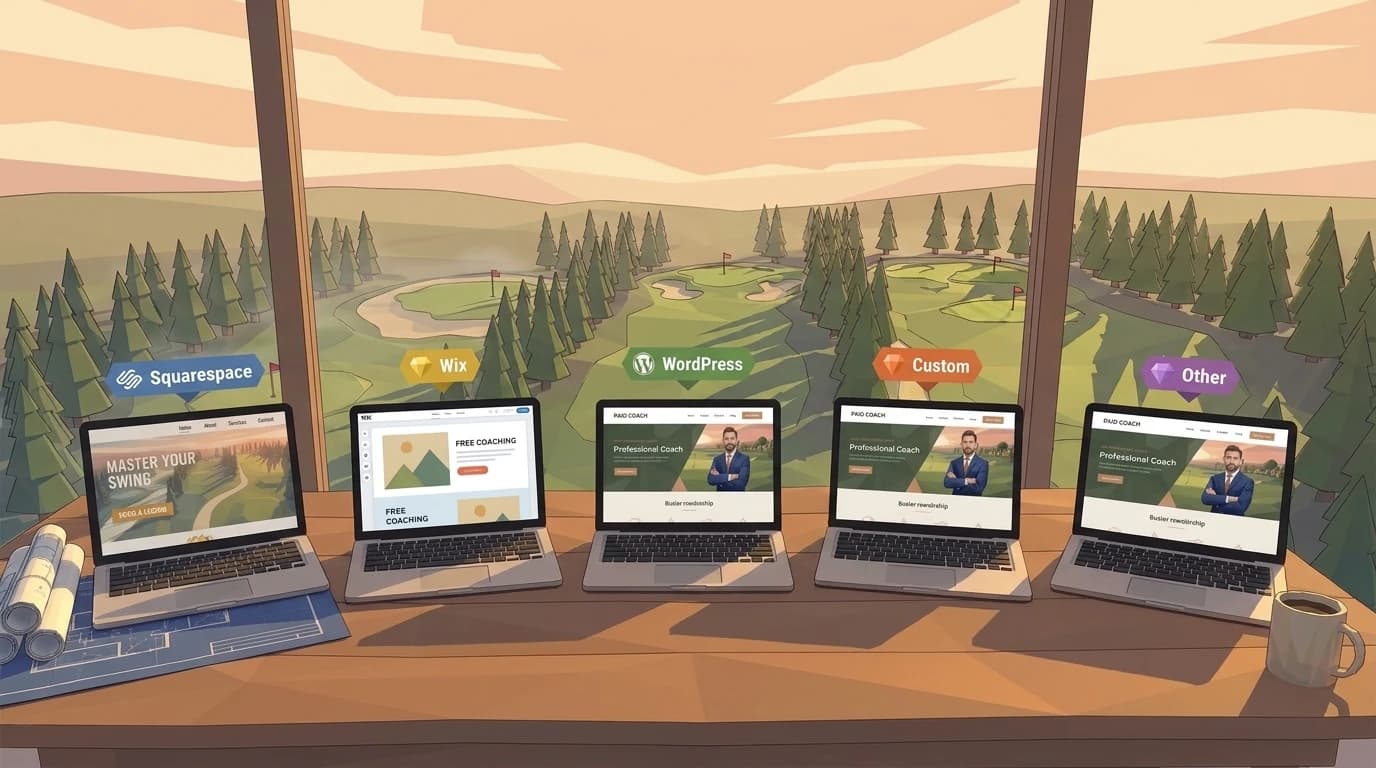
Four real free options exist in 2026. Each one is free in a different way, and each one strips out something different to keep the price at zero.
- Wix Free. A
yourname.wixsite.comURL. Wix ads displayed on every page. 500 MB storage cap. No e-commerce. No custom email. No Google Analytics integration on the free tier. Wix Bookings is technically available, but the booking widget shows ads alongside your scheduling. - Weebly Free. A
yourname.weebly.comURL. Weebly footer ad on every page. 500 MB storage. SquareUp integration available for booking, but you pay transaction fees on every dollar. - Carrd Free. A
yourname.carrd.coURL. One-page only. No custom domain. Three sites max per account. Best for a single-page bio link, not for an actual coach business. - Google Sites. A
sites.google.com/view/yournameURL. Free, fast, ugly. No e-commerce. Limited templates. Looks like an internal-team wiki because it's the same product Google built for internal-team wikis.
The thing all four share is the subdomain. Your URL is not your name. Your URL is yourname.platform.com, which is a different thing. Parents notice. They might not articulate it — they don't read the URL bar consciously — but the booking rate moves.
Read the spec coaches actually need for the full 12-point version of what a coach site has to ship. The short answer: a custom domain is point four on the list. Free options don't deliver it.
The five hidden costs of a free website
The platform fee is $0. That's the headline. The other five lines are where the actual price lives.
The five hidden costs, in order of how much they actually cost a working coach:
- The subdomain trust tax. Same site, different URL — booking rate drops. We've watched it happen on migration projects.
- Your time. Coaches we interviewed during retrofit research averaged 8 hours a month maintaining a free Wix or Weebly site. At a $90 lesson rate, that's $720 a month of unbilled work — $8,640 a year.
- Slow mobile load. Free templates are heavier than paid ones. Per Sitebuilder Report's 2026 analysis, median LCP on free/cheap-tier templates runs 2.4-3.2 seconds. Per Google's Core Web Vitals docs, the threshold for a "good" mobile load is 2.5 seconds. The next coach's custom site loads in under 1.5. Multiply across a year of searches and the speed gap costs bookings — call it 4 missed a month at $90, $4,320 a year.
- Ad placement. Free Wix shows Wix ads. Free Weebly shows Weebly ads. Your potential client is looking at a competing website builder's pitch on the page where they're trying to book a lesson with you. That's a literal description of what's happening.
- The migration cost. When you finally upgrade — and most coaches do — the cost of moving is real. Old indexed URLs that 404. Content that needs rewriting. The SEO dip during the switchover. The earlier you migrate, the smaller this number gets.
Add those five together and the "$0" platform fee starts looking like the smallest line on the bill.
The year-one math — Laura's free Wix vs Laura's $99/mo custom site
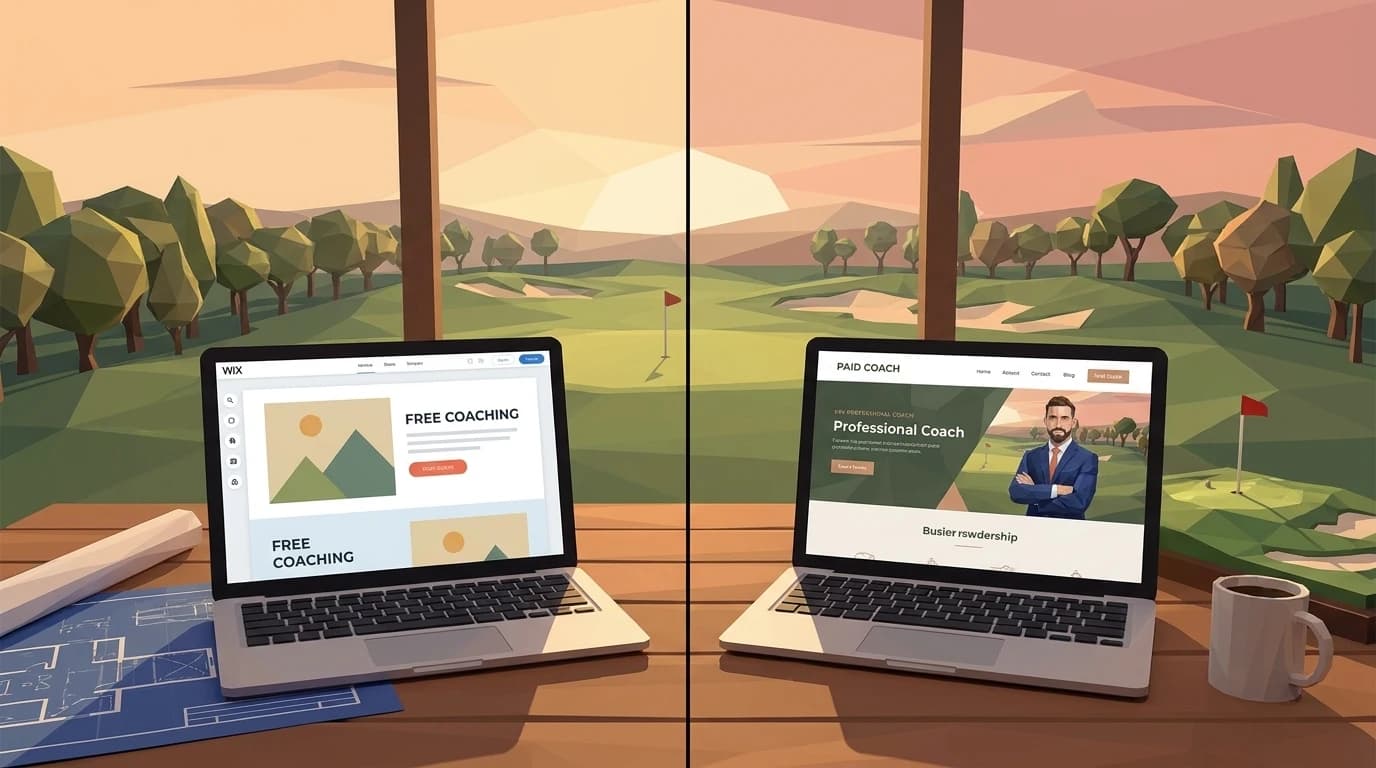
Here's the side-by-side. Same coach. Same lessons. Same five-page site, structurally. Two different URLs.
| Cost line | Free Wix (year 1) | Productized custom $99/mo (year 1) |
|---|---|---|
| Platform fee | $0 | $1,188 |
| Custom domain (separate) | $20 | Included |
| Acuity / booking add-on | $240 | Included |
| Coach time (avg 8 hrs/mo at $90/hr equivalent) | $8,640 | ~$0 (email change requests, 1-3 day turn) |
| Lost bookings (4 missed/mo from 4-5s mobile load) | $4,320 | $0 (sub-1.5s load) |
| YEAR-1 NET COST | $13,220 | $1,188 |
The number that matters isn't $13,220 versus $1,188. It's the gap — about $12,000 a year of unrealized revenue and unbilled time that the "free" headline doesn't show. That number is conservative. Coaches who teach junior programs at higher seasonal volumes lose more in bookings during March-and-April signup windows; the lost-bookings line gets bigger when the search volume gets bigger.
If the time number feels off — "I don't spend 8 hours a month on my website" — log it for one month. Most coaches who track it for the first time are surprised. The Sunday nights add up faster than they feel like they should.
For the deeper version of the cost framing, the team's full pricing math walks through the productized side line by line. For the broader cost-tier breakdown across DIY, freelancer, agency, and productized, the full cost-tier breakdown is the version that includes every option.
When free is actually the right call
Free is sometimes the right call. We'd rather you know that now than three months in.
The first situation is the most common. A coach who just got certified, has zero clients, isn't sure if the practice will take, and needs a placeholder URL while they figure it out. Putting $99/month into a website before there's a single lesson booked is bad math. Free Wix is fine. Park the URL. Test the demand. Migrate when the demand shows up.
The second situation is the one most articles get wrong. There are coaches who teach for the love of it, run two or three lessons a weekend, don't market beyond word of mouth, and don't want a "real" business. For them, a website is a bio page, not a sales engine. Free Carrd or Google Sites does the job. Don't let anyone — including us — sell them past their actual need.
The third situation is the math one. If you're booking three lessons or fewer a week at $50-80 a piece, the gross revenue runs $7,800-12,500 a year. Spending $1,188 of that on a productized custom website is a real percentage of the total. The math gets thin. Free is rational at that scale, even if the URL is wixsite.com.
Past those three situations, the trade flips. You're losing more in bookings and time than you're saving on platform fees.
The "free" trap most coaches don't see
The trap is compounding. Year one of free isn't the problem. Year three is.
By year three, the math looks like this. You've spent zero on platform fees — call that $0 saved. You've spent ~26 hours a month maintaining the site as your practice grew (the maintenance burden scales with how much you teach). At a $90 lesson rate, three years of that is north of $25,000 in unbilled time. You've lost roughly $13,000 in bookings to mobile speed gaps. And when you finally migrate, you discover that the old wixsite.com URLs are still indexed, your link equity is zero (because nobody links to a wixsite.com), and the SEO dip during the switchover takes 60-90 days to recover.
I spent two years on Wix free thinking I was saving money. The migration cost more than the two years would have. The number that hurt was the link equity — I had nothing to forward, because nobody links to a wixsite.com URL.
That's the trap. Free is cheapest in year one, neutral in year two, and the most expensive option in year three.
The earlier you migrate, the cheaper the move. The longer you stay, the more indexed URLs and the more migration friction. If you're going to leave free eventually, leaving sooner is the cheaper move. The migration math from Squarespace is the version of this calculation for coaches already on a paid platform; the free-tier version is the same math with bigger numbers.
For the deeper itemized breakdown of the productized alternative — what $99 a month actually buys, line by line — the $99/month spec, line by line is the deep dive.
Laura's spring camp email did go out the next morning. It went to four hundred and twelve parents. The button linked to a page that still said 2024 in the header. She got fewer signups than the year before. She didn't connect the two until June, when she finally migrated to a custom site, fixed the header, fixed the URL, and watched her summer-camp signups outpace the spring number by 30 percent. The site wasn't the only reason. It was a real reason.
Frequently asked questions
Four real ones in 2026: Wix Free, Weebly Free, Carrd Free, and Google Sites. Each strips something load-bearing. Wix Free shows Wix ads on your pages. Weebly Free does the same with a Weebly footer. Carrd Free is one-page only. Google Sites looks like an internal team wiki. All four come with a subdomain that reads as an experiment to parents — `yourname.wixsite.com` instead of `yourname.com`. Free is real; the trade-offs are also real.
Yes, in the first 90 days while validating demand. That's the right move when you don't have paying students yet and can't justify spending on a paid platform. Past those first 90 days, the math flips because the time cost compounds. If you're booking three or more lessons a week consistently, the platform you're saving money on is costing you bookings and Sunday nights. The migration is cheaper the earlier you do it.
Parents searching at 9 PM read `yourname.wixsite.com` as an experiment, not a business. They don't articulate it consciously. They don't even consciously read the URL bar. They just don't book at the same rate. We've watched the booking number move on migration projects — same coach, same testimonials, same lesson rates, different URL. The trust tax is real and it's measured in lost bookings, not feelings.
Free runs $0 in platform fees plus roughly $13,000 a year in time and lost bookings, conservatively. Productized custom runs $1,188 a year, all-in. The gap is about $12,000 a year of unrealized revenue and unbilled time. The headline price is the smallest line item in the actual comparison. The time number is the biggest one most coaches don't track until they look.
Most paid platforms include a free first-year custom domain. Free platforms don't — they keep you on the subdomain because that's what makes the free tier free. Year-2 costs are where the "free" claim falls apart. The domain you get on a free Wix site in year one is `yourname.wixsite.com`, and that's what it stays.
Three signals. You're booking three or more lessons a week consistently — the gross revenue can absorb the platform cost. You've spent more than five hours in a single weekend trying to fix something on the site — your time is becoming the bottleneck. Or a parent has asked "is this site real?" — the trust tax has crossed from theoretical to actual. The third signal is the real one. The first two are warnings.
Last updated .
Keep reading