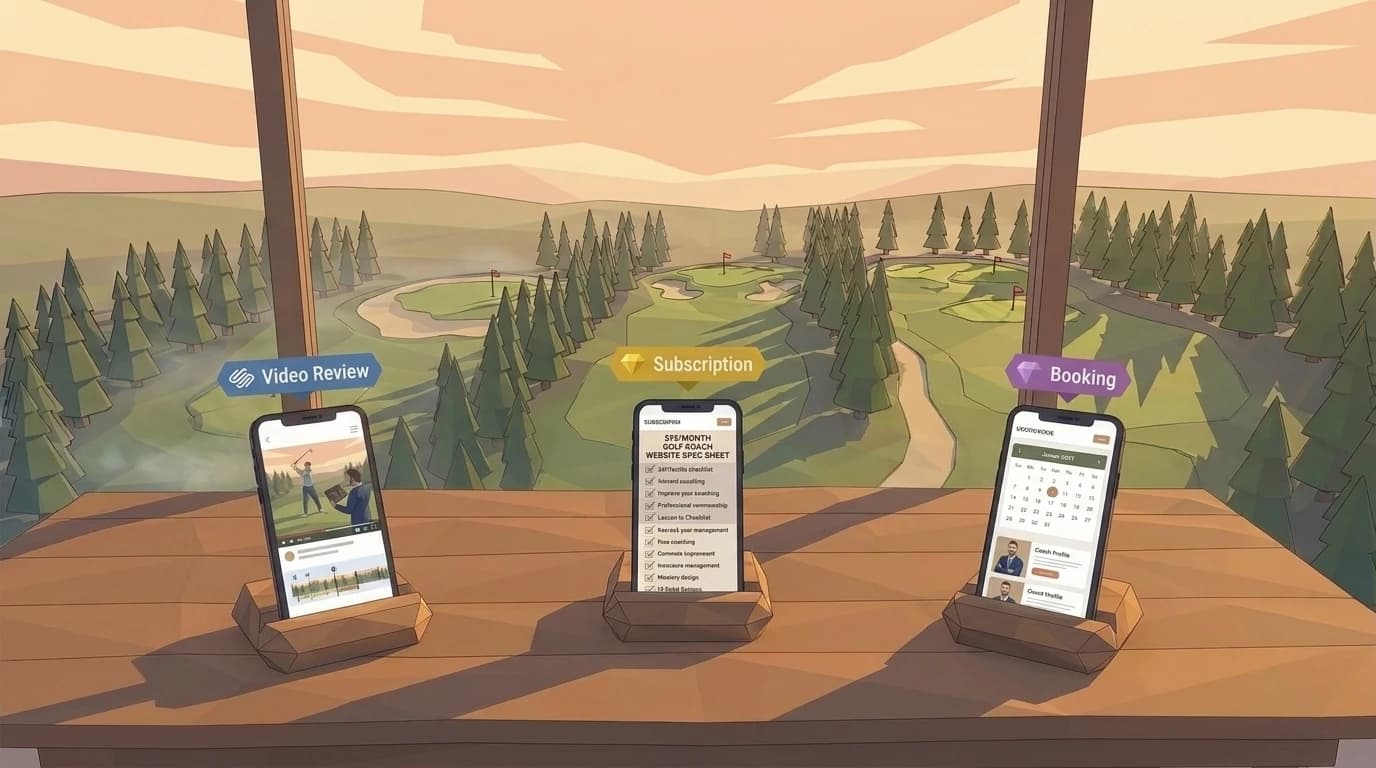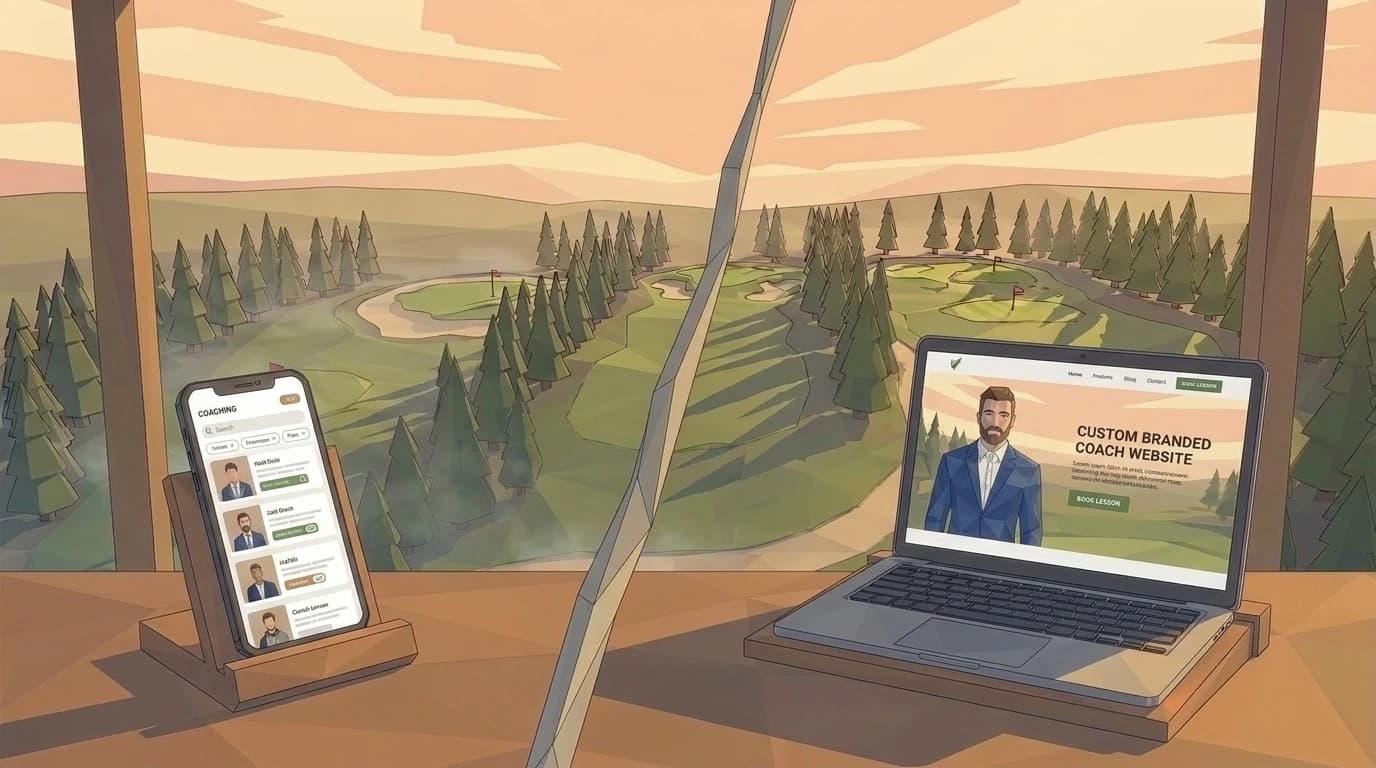
It's 3:11 on a Sunday afternoon. Mark is on his back porch in Phoenix. His daughter is at a birthday party two streets over, the house is quiet, and there's a half-finished beer on the side table. His phone is open. The browser tab is Skillest's "Become a Coach" page — the same page he's pulled up three separate times in two weeks. He keeps reading the 15% commission line, doing the math in his head, getting stuck on the same question. Is the 15% worth it? Or is he better off building his own site and keeping all of it? He scrolls down. Closes the tab. Opens it again four minutes later. He's not closer to an answer than he was the first time.
The reason he's stuck is that he's asking the wrong question. The question isn't "Skillest or my own website." The question is: what month of your business are you in. Because the right answer at month one is the wrong answer at month twelve, and most coaches lose three to five years of compounding because they pick one and never revisit.
The decision framed honestly
Most articles on this topic treat the comparison like a static one. They line up Skillest's features against a custom website's features and let the reader pick. That's the wrong frame.
The right frame: which one is correct depends on the month you're in. A coach with no email list and no audience faces a different math problem than a coach with a hundred students and an established Google ranking. Same coach, three years apart, two different answers.
Month one — when the app wins
You're new. You have zero email list, zero Google ranking, zero social audience. Your own custom website, no matter how beautifully built, delivers nobody. Because nobody knows it exists.
Skillest, on the other hand, delivers the first five students inside thirty days. Per their public coach page, Skillest takes 15% per lesson. The math at month one is brutal in a way most coaches don't want to think about: 15% of zero is zero. 100% of zero is also zero. The platform's customer acquisition is worth its commission because there is no other channel currently producing revenue.
This is the part of the comparison where most "build your own site!" articles fall apart. They assume you have an audience. You probably don't, yet. Skillest is your audience for a while.
Month twelve — when the math flips
Twelve months in, you have twelve active subscribers — maybe ten through Skillest, two through referrals from existing students. At $129/mo per student, that's $1,548/mo gross. Skillest's 15% take is $232/mo.
Your own site stack — CoachNow at $24.99/mo plus a website at $99/mo — costs $124/mo total. That's $108/mo cheaper than the Skillest commission already, and that's at twelve students. The break-even crossed somewhere around student seven.
Worked numbers:
- At 12 students: Skillest takes $232/mo. Own-site stack costs $124/mo. Own site wins by $108/mo.
- At 20 students: Skillest takes $387/mo. Own-site stack costs $124/mo. Own site wins by $263/mo.
- At 40 students: Skillest takes $774/mo. Own-site stack costs $124/mo. Own site wins by $650/mo.
The math compounds. The bigger your book gets, the more expensive the marketplace becomes — because the marketplace's cost scales with revenue and the website stack doesn't.
For the website stack itself — what's actually in $99/mo and what isn't — see what the own-site half of the hybrid actually costs.
The email-list compounding
The commission math is the visible cost. The email-list cost is the one most coaches don't see until year three.
Year one. Twelve active students. Eight churned through. Skillest has all twenty emails. You have zero.
Year two. Twenty-four active students. Sixteen more churned through. Skillest has sixty emails. You have whoever you got off-platform.
Year three. The active subscriber count is similar. But Skillest has a database of every person who ever tried your coaching, including the eighty-something who churned. They send those people other coaches' profiles. You have no way to reach them. Their handicap creeps back up two years from now and they want help — Skillest gets to decide who they see. Not you.
| Year | Active subscribers | Cumulative signups | Skillest only — owned emails | Own site only — owned emails | Hybrid — owned emails |
|---|---|---|---|---|---|
| Year 1 | 12 | 20 | 0 | 12 | 12 |
| Year 2 | 18 | 44 | 0 | 32 | 32 |
| Year 3 | 22 | 72 | 0 | 56 | 56 + Skillest leads |
| Year 5 | 30 | 140 | 0 | 112 | 112 + ongoing leads |
The active-subscriber count is roughly the same across all three setups. The owned-email count is dramatically different. By year five, the hybrid coach has 112 owned emails plus an ongoing Skillest lead source. The Skillest-only coach has 30 active subscribers and no way to reach the other 110.
The hybrid setup most successful coaches actually run
The coaches doing this well aren't picking one. They're running both, on purpose, with a deliberate schedule for moving students between them.
The pattern:
- Skillest as lead source. New students discover the coach through the Skillest directory. The 15% commission funds the customer acquisition.
- Own website as home base. Every Skillest student gets an early-relationship nudge to "subscribe to my newsletter at [yoursite].com" — usually within the first month, framed as a freebie (a swing-fundamentals PDF, a drill library, whatever fits).
- Email-list capture happens off-platform. The email goes into the coach's list, not Skillest's. Even if the student stays on Skillest for another year, the email is now owned twice — by both parties.
- At month six or twelve, the migration conversation. "I've moved my coaching off Skillest — same plan, same price, billed directly through my site, here's the link." Some students migrate. Some don't. The ones who migrate are now fully owned. The ones who don't, the coach still has the email.
That's the real 2026 setup. Marketplace for distribution. Own site for relationship. Per the 2026 Onform trends report, coaches moving from pay-per-lesson to pay-for-access subscriptions almost universally need this dual-channel approach to make the unit economics work.
For the platform-specific breakdown of what each one actually offers, see the full platform comparison.
The CoachNow exception
A common confusion: "Should I use CoachNow or my own website?" That's a category error. CoachNow isn't a marketplace. It doesn't bring you students. It doesn't take a commission.
CoachNow is $24.99/mo flat per G2's pricing data. It's the workflow layer where the actual coaching happens — video upload, telestration, written feedback, chat. It pairs with your own website, not against it. CoachNow handles the video. Your site handles the booking, payment, email capture, and brand.
The same logic applies to Onform, V1 Sports, and any other tools-only product. They aren't substitutes for your website. They're complements. The decision tree is "which marketplace, if any, plus which workflow tool." Not "marketplace or workflow tool."
The decision tree — which to pick when
The honest answer most articles dodge:
- 0-5 students. Skillest or TeachMe.To, full stop. Build the email list separately from day one — even a Google form will do. Don't bother with a custom website yet.
- 5-15 students. Run Skillest plus your own site in parallel. The marketplace is still cheaper for new-student acquisition. The website is the home base for retention and email-list capture.
- 15+ students. Own site primary. Skillest as overflow lead-gen. The math has flipped — Skillest is now an expense item, not a savings item, and the email list you've built off-platform is the asset that's compounding.
For the broader pillar context — how the platform decision sits inside the full remote coaching practice — see the platform-vs-own-site decision in the broader pillar.
I told coaches for two years to skip Skillest. I was right for the wrong reason. The 15% is fine — what's not fine is using Skillest as your only layer. Both can be true.
Frequently asked questions
Frequently asked questions
Both. Skillest at month one for customer acquisition you can't otherwise buy. Your own website by month six as the home base where retention and email-list ownership live. The mistake isn't picking the wrong one — it's picking only one and never revisiting the decision.
Skillest is the cheapest at month one — $0 monthly fee, 15% per lesson. The cheapest long-term, once you have more than seven active subscribers, is your own site plus CoachNow at roughly $125/mo all-in. Below seven subscribers the marketplace wins on cost. Above seven, the own-site stack wins, and the gap widens every quarter.
Yes. Most successful online coaches in 2026 do exactly that. Skillest doesn't have an exclusivity contract for solo coaches — you can list there and run your own site without violating any terms. The hybrid setup is the working pattern: marketplace for lead-gen, own site for retention, deliberate migration on a schedule.
Apps like Skillest are platforms with built-in audiences, built-in commission structures, and built-in customer relationships the platform owns. Your own website is your home base — no built-in audience, no commission, full control. Apps solve customer acquisition. Websites solve customer ownership. The two solve different problems and most coaches need both.
Roughly seven active monthly subscribers at $129/mo, accounting for a $124/mo website plus tool stack. At twelve subscribers you're saving about $108/mo by being on your own site. At forty subscribers you're saving about $650/mo. The break-even is the volume at which Skillest's 15% take exceeds your fixed website plus tool cost.
Not contractually — Skillest doesn't have an exclusivity clause for solo coaches. But the platform's recommendation engine deprioritizes coaches who openly pull students off-platform. The trade is real. The way most coaches handle it: keep Skillest active for new-student acquisition, migrate longstanding students gradually, don't make the migration a public campaign. Quiet works better than loud.
We sell websites. Of course we think you should have one. The honest qualifier: not at month one. Month one, the marketplace probably wins for the customer-acquisition reason above. The website matters at month six and beyond, when the math flips and ownership starts compounding. If you're at that month and looking for the website side, the team's full pricing math lays it out.
Mark closed the Skillest tab Sunday afternoon. He opened it again Tuesday morning. This time he claimed the profile. He also bought the domain. He hasn't built the site yet — that's a project for next month — but the decision wasn't between the two. It was both, with a schedule. The schedule starts now.
Last updated .
Keep reading