It's a Wednesday afternoon in mid-June. The PAT is Saturday at the Cincinnati Country Club. Alex is at the public range four blocks from his house, trying to groove a swing he hasn't played competitively in eleven years. The range is empty except for two retirees on the back row hitting half-shots with hybrids.
Alex has just put his fourth tee shot in a row into the right rough. Not just the right side of the fairway — the actual right rough, past the 175-yard tree he's been using as a sight line. He stops. He sets the driver down on the bag. He looks at the cart fan blade on the irrigation pole, and he says out loud, to nobody, "I'm not ready."
He paid $200 for the qualifying portal in February. $40 for the qualifying test in April. $60 for the background check the same week. He passes the portal coursework on his first try. The PAT is the wall. He knows it. He's known it since he printed the PGA's published cost overview on his work printer six weeks ago.
The PAT is the wall. I'm not going to pretend it isn't. The cert is real. The cert costs you 4-4.5 years and $25-30k all-in. Take that seriously before you start.
The full timeline at a glance
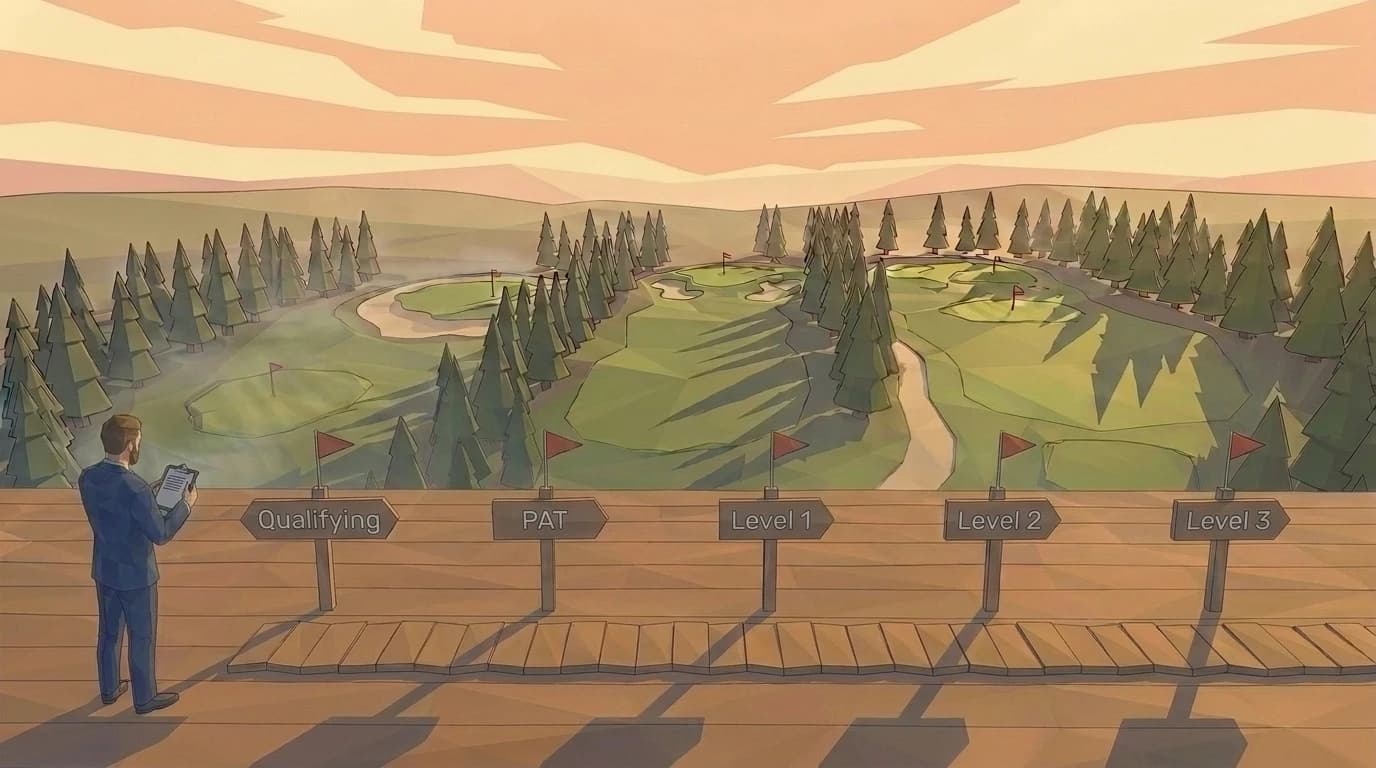
Per the PGA of America's published 2026 cost overview and the FGCU PGM bachelor's program (which independently tracks 4.5-year average completion data), the full path from Day 1 of Qualifying to Full Member status runs about 54 months. Breaking it into the five stages most aspirants think about:
- Qualifying — months 1-6
- Player Ability Test — variable timing, often months 4-12
- Level 1 — months 6-18
- Level 2 — months 18-30
- Level 3 + Class A-3 Associate year + Final PAT — months 30-54
The thing nobody tells you up front: the Final PAT requirement at the end is real. You take a PAT to start the program. You take another PAT — typically a stiffer target — to finish it. Two playing tests, four years apart.
Stage 1 — Qualifying (months 1-6)
Per PGA Form 252, the qualifying-stage fees:
- Online portal access: $200, valid 6 months. If you don't pass the qualifying test within that window, the portal renews at $200.
- Qualifying test: $40 at a PSI center near you. Valid 12 months once passed.
- Background check: $60 one-time.
That's $300 in published fees for Stage 1. The work itself is roughly 40 hours of online coursework — modules covering golf history, basic teaching theory, PGA structure, and the rules-of-golf primer. Most aspirants finish in 8-12 weeks of part-time evening work.
The qualifying test isn't the wall. It's a multiple-choice exam over the coursework. Pass rate is high if you actually do the modules.
Stage 2 — The Player Ability Test
This is where 60-70% of aspirants stall. The exact pass rate isn't publicly published, but PGA.com's own overview frames the PAT as the most variable stage of the path.
The mechanics:
- Cost: $100/attempt + facility green fees (typically $40-100, varies by host facility)
- Format: 36 holes in a single day at a PGA-section-approved facility
- Target score: roughly a 15 handicap equivalent over 36 holes — varies by section and is published by your local PGA section ahead of each PAT date
- Retakes: unlimited, on a per-section schedule (usually 4-8 PAT dates per section per year)
Anecdotally, 3-5 attempts is common for first-time aspirants. Some pass first try. Some never pass.
The PGA Members Council voted in 2023 to allow alternative pathways that bypass the strict PAT-as-gate model in some employment-based situations. Verify the latest with your section before you assume you're hard-gated by a single qualifying round.
Stage 3 — Level 1 (months 6-18)
Once the PAT clears, Level 1 begins. The cost structure:
- Portal: $560
- Seminar at the PGA Education Center in Frisco, Texas: $2,000
- Tests (5 courses): $78 cumulative
- Travel/lodging for the seminar: $1,000-2,000 (varies by your home market)
Total stage cost: $3,638-4,638. Duration: typically 6-12 months including the work-experience requirement. Most aspirants clear Level 1 by month 18 of the overall program.
The seminar is in person at the PGA Education Center. It's not a webinar. Plan for travel time off work plus the lodging cost.
Stage 4 — Level 2 (months 18-30)
Same shape as Level 1, with a slightly cheaper portal:
- Portal: $350
- Seminar: $2,000
- Tests: $78
- Travel/lodging: $1,000-2,000
Total stage cost: $3,428-4,428. Duration: 6-12 months. Most aspirants clear Level 2 by month 30.
Stage 5 — Level 3 + Full Member (months 30-54)
The longest stage. Same Level structure plus the Class A-3 Associate year plus a Final PAT requirement:
- Portal: $350
- Seminar: $2,000
- Tests: $78
- Travel/lodging: $1,000-2,000
- One year as Class A-3 Associate (working in an approved PGA member-supervised role)
- Final PAT: $100/attempt at a stiffer section-specific target
Total stage cost: $3,428-4,428 in fees, not counting the year of supervised work experience. Total time-to-Full-Member from Day 1: 4-4.5 years.
The all-in cost reckoning
Here's the math the PGA's published estimates don't fully spell out:
| Stage | Months | Core fees | Travel/lodging | Stage all-in |
|---|---|---|---|---|
| Qualifying | 1-6 | $300 | n/a | $300 |
| PAT | varies | $200-500 (2-5 attempts) | Green fees | $200-500 |
| Level 1 | 6-18 | $2,638 | $1-2k | $3,638-4,638 |
| Level 2 | 18-30 | $2,428 | $1-2k | $3,428-4,428 |
| Level 3 | 30-42 | $2,428 | $1-2k | $3,428-4,428 |
| A-3 year + Final PAT | 42-54 | $200-500 | n/a | $200-500 |
| Subtotal — fees and travel | 54 months | $8,194-8,594 | $3-6k | $11-17k+ |
That's the published-fee subtotal. Add section dues across 4 years (~$500-1,000/year × 4 = $2-4k). Add a couple of seminar trips that ran longer than expected. All-in: $25,000-30,000 base.
Add the 4-year degree component (FGCU or Keiser PGM bachelor's), and tuition adds $60-80k over 4 years. All-in with degree: $90-110k.
Plus the opportunity cost — 4-4.5 years where the work-experience requirement caps how much you can earn during the program. Most Associates work in supervised roles at $35-55k/year during the program. If your alternative is a $90k pharmaceutical-sales job, the opportunity cost is roughly $200k over 4 years before you account for the cert paying off.
Where this is worth it (and where it isn't)
Worth it: country-club career trajectory, tour-coaching aspirations, broad industry recognition, head pro positions at private clubs. The PGA path opens doors no other credential opens at the country-club tier — particularly in the Northeast.
Not worth it: indie / online / range-only career. USGTF gets you teaching paid lessons in 4 days for $1,795. The PGA path gets you teaching paid lessons 6+ months in (after Qualifying + PAT) for $300-800 in upfront fees, and the full credential 4-4.5 years in for $25-30k. If your goal is the indie practice, the math doesn't pencil.
Frequently asked questions
Frequently asked questions
4-4.5 years on average from Day 1 of Qualifying to Full Member. The bottleneck is usually the Player Ability Test, not the coursework. Many aspirants take 3-5 PAT attempts before passing — each one is $100 plus facility green fees, and each one eats a full day. If you bundle the 4-year degree component (FGCU or Keiser PGM bachelor's), the total time stays around 4-4.5 years, but the degree adds $60-80k tuition.
Core fees: about $8,414 across all four stages, per the PGA's published 2026 cost overview. All-in cost (with travel, lodging across three Frisco seminars, section dues, and a few PAT retakes): $25,000-40,000+. With the 4-year degree component at FGCU or Keiser PGM: $90-110k. Plus the opportunity cost of 4 years in supervised Associate roles at $35-55k/year — if you'd otherwise have been earning $90k+, the opportunity cost adds another $150-200k.
Roughly a 15 handicap equivalent over 36 holes, but the exact target varies by section. Your local PGA section publishes the specific PAT target ahead of each test date. The 36-hole format means two rounds in a single day at a PGA-section-approved facility. Each attempt is $100 plus the host facility's green fees (typically $40-100). Multiple attempts are allowed.
Yes, with equivalent work experience. The PGA Members Council allows an experience-based equivalency path that's section-specific. The exact equivalency requirements vary, so verify with your local PGA section before you assume. The degree-bundled path (FGCU or Keiser PGM bachelor's) consolidates the requirement into one decision but adds 4 years of college tuition. If you already have a bachelor's in any field, the PGA's degree requirement is satisfied — you don't need a golf-specific degree.
No publicly published median, but anecdotally 3-5 attempts is common for first-time aspirants. Some pass on the first try. Some never pass. Each attempt is $100 plus facility green fees and eats a full day plus the prep round in the week before. Coaches who pass early usually have a structured prep routine in the 6 weeks before the test. Coaches who don't pass typically started prep too late or hadn't played competitive golf in 5+ years before scheduling the attempt.
A-1 is Head Professional (the senior teaching/operational role at a club). A-3 is the Associate working toward Full Member status — you're A-3 during the back end of the program in the work-experience year. A-7 is Teaching Professional (focused on instruction rather than club operations). The full Class designation list also includes Director of Golf and other operational roles — the complete chart lives at PGA.org. For the certification path, you're an Associate (A-3) for 4-4.5 years, then become a Member with a specific Class designation tied to your post-cert role.
Yes — for each Level seminar. The Level 1, Level 2, and Level 3 seminars are held in person at the PGA Education Center in Frisco, Texas. Travel and lodging are not included in the seminar fee. Plan for $1,000-2,000 per seminar trip depending on your home market. The portal coursework between seminars is online; the seminars themselves require showing up.
Once Alex passes, the website becomes the bottleneck
Alex passed the PAT on his second attempt. October, not June. He shot 78-82 on a windy Saturday at Eagle Creek and walked off the 36th green not knowing if he'd cleared the section's target until the scoring tent confirmed it. He started Level 1 the following spring.
Year 1: Alex is in supervised Associate hours at a country club outside Cincinnati. He has a half-day of teaching access on Wednesdays and Sundays and runs his own lesson book at the public range three weekday evenings.
Month 18: Alex has 8 students of his own. He's billing $75/hour at the range, $90/hour at the country club. His Level 1 portal is in week 3 of 5 modules. His website is a Squarespace from a template — the resort one, the same one his cousin's wedding photographer uses — and the booking page goes to a Calendly link that uses his old gmail.
Month 30: Alex has 12 students at the country club, 6 at the range. He's deep in Level 2. The bottleneck on his book isn't the cert anymore — it's that 30% of new-student inquiries come from parents Googling his name on Tuesday nights, and the parents who land on the resort-template Squarespace either don't book or book a different coach.
Once your first ten students are on the books, the website becomes the bottleneck. The PGA path gets you the cert and the country-club hiring access. The website gets you the parent who heard your name at the PTA meeting on Monday and Googled you Tuesday night.
We build the website that handles the Tuesday-night parent. The team's full pricing math is on the pricing page if you want to see what we charge. The local-search piece every new coach skips is the highest-ROI thing to set up before the website work even starts. And the wider plan for the first 12 months — including what PGA-certified instructors actually earn once the cert lands — is the part of the path the PGA cost overview leaves blank.
The PGA path is real. The path after the PGA path is the website.
Last updated .
Keep reading