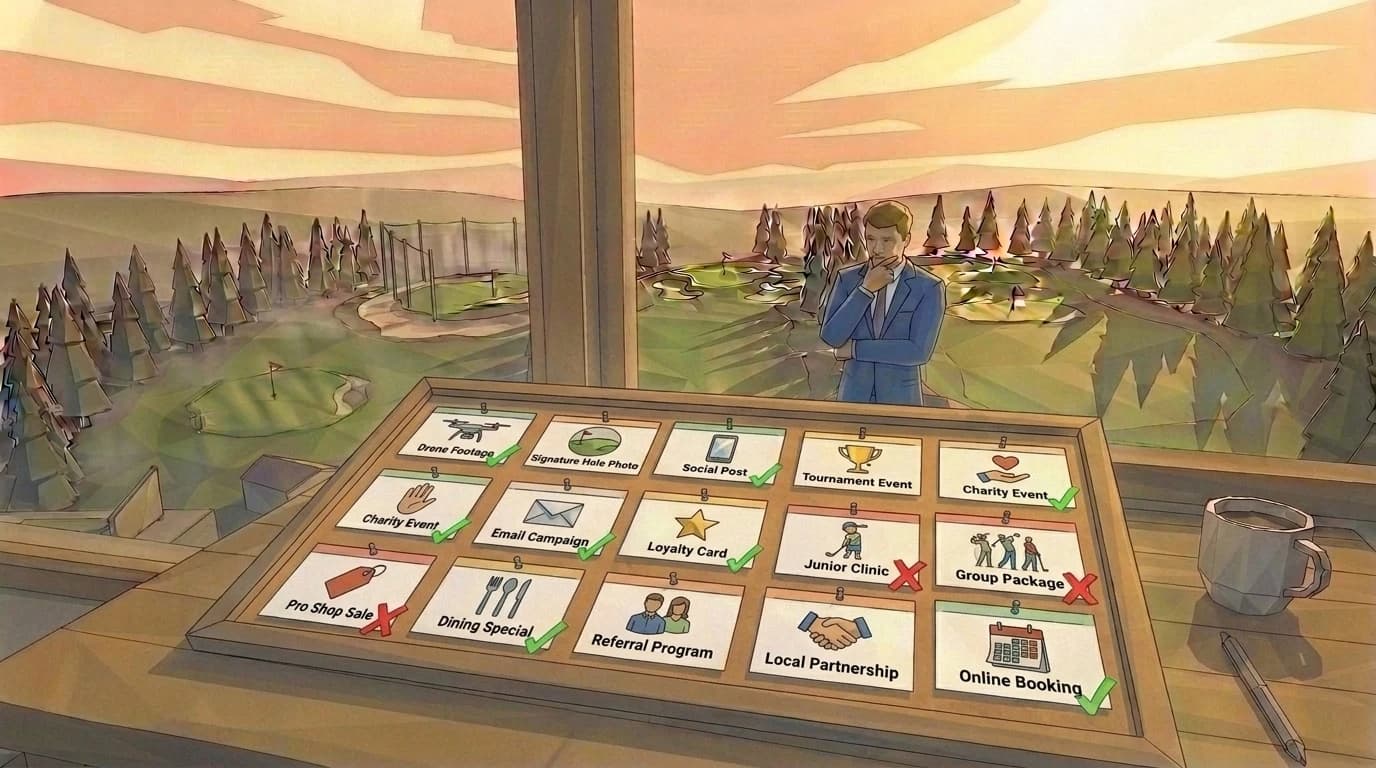
Diane is back in her office on a Tuesday afternoon. The vendor just left. Ninety minutes. Thirty slides. Thirty marketing ideas in thirty slides. The leave-behind is an A4 booklet with two columns of body copy in 8-point type. She slides her readers down off her head and starts at the top of column one. None of the ideas have a price next to them. None of them have a revenue projection. The deck mentioned ROAS twice and never defined how it was being calculated.
She closes the booklet. She has 14 emails to answer before the cart barn meeting at 4. She knows she's going to set the booklet on the radiator next to the other three from the last 18 months and not open it again.
This list is the version that Tuesday afternoon needed. Fourteen ideas with the actual revenue uplift attached. Six things to stop doing. The order to start them in, because nobody can run all 14 at once. We don't run a marketing agency for golf courses, but we sit in on enough of those vendor presentations to know which ideas survive contact with a real P&L.
Why most "golf course marketing ideas" lists don't move the needle
The pattern is the same on every "30 ideas" listicle on the first page of Google. Thirty ideas. Zero revenue numbers. Every idea written at the same level of abstraction, so you have no way to tell which one matters. The list is designed to keep you reading, not to help you fill weekday tee times.
This list does the opposite. Each idea has a target persona, a realistic uplift, an implementation cost, and a payback window. Some of the uplifts are smaller than the listicles imply. None of them are speculative.
Most courses we audit are running 11 marketing tactics. Three of them produce 80% of the rounds. Doing the other eight badly is what "busy" looks like.
The uplifts below are based on the patterns we've seen across mid-tier public courses (50-150 weekday rounds/day capacity, $35-$65 average green fee). Higher-end semi-private and resort courses can scale these — the percentage uplifts hold; the absolute revenue numbers double or triple. Lower-end municipal courses won't see the same numbers because the audience density isn't there.
The 14 ideas that work — with actual numbers
Each idea below: name, target audience, realistic revenue uplift, implementation cost, payback window. Numbers are conservative. The good operators beat them.
- Dynamic weekday twilight pricing. Target: price-sensitive local golfers. Uplift: 12% fill rate increase on the 2-5pm slow window. Cost: $200-$500/mo for a yield-management tool (Sagacity, Lightspeed dynamic pricing module) plus 2 hours/week of GM oversight. Payback: 30-45 days. The single fastest revenue lift in this list.
- Women's twilight clinic series. Target: women who've never played your course (largest underserved demographic in US golf per NGF participation data). Uplift: 10% boost in female membership conversion + 6-8% lift in F&B per attended session. Cost: head pro time + $300-$800 marketing per series. Payback: one full season.
- Corporate league recruitment. Target: companies within 15 miles. Uplift: 15% weekday revenue lift across 12-week leagues. Cost: head pro and GM outreach time + league management software ($30-$100/mo). Payback: first league cycle.
- Signature hole video contest. Target: existing golfer audience for social engagement and email list growth. Uplift: 8-12% booking lift across the 90 days the contest runs. Cost: $0 platform fees plus $200-$500 in prize value. Payback: contest period.
- High school golf partnership. Target: junior golfers and their parents. Uplift: 7% junior revenue growth + long-tail family-round bookings. Cost: free range time donation + 1-2 staff hours/month. Payback: spring/summer season.
- Annual charity scramble hosting. Target: local nonprofits and the corporate networks they bring. Uplift: 10% ancillary spend lift on event day + 60-120 day booking tail (typically 30-80 incremental rounds). Cost: time + reduced green fee for the day. Payback: event day plus 4 months.
- Winter golf simulator membership. Target: dormant winter golfers (regions with seasonal closure). Uplift: 20% winter revenue at courses that didn't have winter revenue before. Cost: $30-$60K capex for the simulator setup. Payback: 18-30 months.
- Walking-only Sunday morning rates. Target: serious golfers, traditionalists, and the 35-55 demographic that wants the round in under 4 hours. Uplift: 9% weekend utilization on the historically slow walking slot. Cost: signage and a starter who enforces the rule. Payback: immediate.
- F&B minimum reduction Mondays. Target: weekday food/beverage revenue. Uplift: 15% F&B sales on the slowest day. Cost: $0 cash, possible $100-$300/mo lost minimum revenue offset by volume. Payback: first month.
- Resort or hotel cross-promotion. Target: visiting golfers in markets with travel demand. Uplift: 12% visitor revenue. Cost: partnership setup time + commission split (10-15% of green fees). Payback: first peak season.
- Junior development camp partnership with regional influencer. Target: youth signups and parent demographic. Uplift: 11% youth signup increase. Cost: $1,500-$5,000 partnership fee depending on creator reach. Payback: 60-90 days.
- Loyalty app with prepaid round packages. Target: regulars who currently play 8-15 rounds/yr. Uplift: 14% retention revenue + 22% increase in average rounds per loyalty member. Cost: $300-$1,000/mo platform + 6-week setup. Payback: 90-120 days.
- Family movie night plus mini-golf events. Target: non-core families for non-golf-day spend. Uplift: 8% non-golf clubhouse spend on event nights. Cost: projector + screen ($500-$1,500 capex amortized) + monthly programming time. Payback: first season.
- VIP referral loyalty boost. Target: existing top-quartile golfers. Uplift: 10% incremental rounds via referrals at $360 average referred-customer LTV. Cost: 2 hours/month + small reward budget ($25-$75 per qualified referral). Payback: 2-3 months.
| Idea | Target persona | Monthly investment | Payback window | Uplift |
|---|---|---|---|---|
| 1. Dynamic twilight pricing | Price-sensitive local | $200-$500 | 30-45 days | 12% fill on twilight |
| 2. Women's twilight clinics | Women new to course | $300-$800/series | One full season | 10% female membership |
| 3. Corporate league recruit | Companies 15 mi radius | Time only | First league cycle | 15% weekday revenue |
| 4. Signature hole video contest | Existing audience | $200-$500 prize | Contest period | 8-12% booking lift |
| 5. HS golf partnership | Junior + parent | Free range time | Spring/summer | 7% junior revenue |
| 6. Charity scramble hosting | Local nonprofits | Time + green fee | Event + 120 days | 10% ancillary + tail |
| 7. Winter sim membership | Dormant winter golfers | $30-$60K capex | 18-30 months | 20% winter revenue |
| 8. Walking-only Sundays | Serious / traditional | Signage | Immediate | 9% weekend utilization |
| 9. F&B min reduction Mondays | Weekday F&B | $0 | First month | 15% F&B Mondays |
| 10. Resort cross-promo | Visiting golfers | Time + commission | Peak season | 12% visitor revenue |
| 11. Influencer junior camps | Youth + parents | $1.5-5K fee | 60-90 days | 11% youth signups |
| 12. Loyalty app + packages | Regulars 8-15 rds/yr | $300-$1K/mo | 90-120 days | 14% retention revenue |
| 13. Family movie nights | Non-core families | $500-$1.5K capex | First season | 8% non-golf spend |
| 14. VIP referral boost | Top-quartile regulars | $25-$75/referral | 2-3 months | 10% via referrals |
For the deeper math on each line item — channel allocation, KPI targets, what each month should produce — see the editable 90-day plan template.
The 6 things to stop doing (or never start)
The harder list. These are the tactics most courses are still running and shouldn't be. Each one is doing real damage in two ways: consuming budget that could be redirected, and consuming attention that could be invested in something on the first list.
- Print ads in the local paper without a tracking offer. No code, no unique URL, no way to attribute. You're paying $400-$1,200/issue for ego and the hope that "people will see it."
- Generic Facebook boost posts. A $20 boost on a "Come visit us!" photo with no offer and no audience targeting. The reach reports look impressive. The booking attribution is zero.
- Branded merch giveaways with no list-capture mechanism. Hats and balls as door prizes that don't ask for an email or a phone number. You gave away $4 of merchandise and got nothing back.
- Newsletter to a list you haven't cleaned in 3 years. The 11% open rate isn't because the content is bad. It's because 60% of the list is dead addresses. Clean before you write better.
- SEO retainer with no GBP cleanup first. Paying $1,500/mo to an SEO agency while your Google Business Profile has 4 photos, a wrong category, and no Posts in 8 months. The SEO retainer compounds against a broken foundation.
- Pro shop sale-only email blasts. You trained your list to expect 30%-off shirts. They open the email, scroll for the discount code, and never click through to anything else. Tee time bookings from this list are statistically zero.
The order to start them in (because you can't do all 14 at once)
Sequence matters as much as selection. The fastest revenue is at the top.
Phase 1, months 1-2. Idea #1 (dynamic twilight pricing). Idea #4 (signature hole contest — runs during phase 1 to build email list growth before you scale email). Idea #9 (F&B min reduction Mondays — zero cash investment, fastest visible result).
Phase 2, months 3-4. Idea #2 (women's twilight clinic — needs the head pro to commit a spring/summer slot). Idea #3 (corporate league recruitment — outreach takes 4-8 weeks; leagues launch month 5). Idea #6 (charity scramble — book the date in month 3 for a fall event in months 8-9).
Phase 3, seasonal. Idea #7 (winter simulator — install in spring/summer, marketing starts in October). Idea #5 (HS partnership — May for fall season). Idea #10 (resort cross-promo — year-round but ramp matches your peak season).
The remaining ideas (#8, #11, #12, #13, #14) are all year-round at any phase, layered in based on which problem is most acute. If your retention number is weak, prioritize #12 and #14. If your community presence is thin, prioritize #11 and #13. If your weekend walkers are vocal, ship #8.
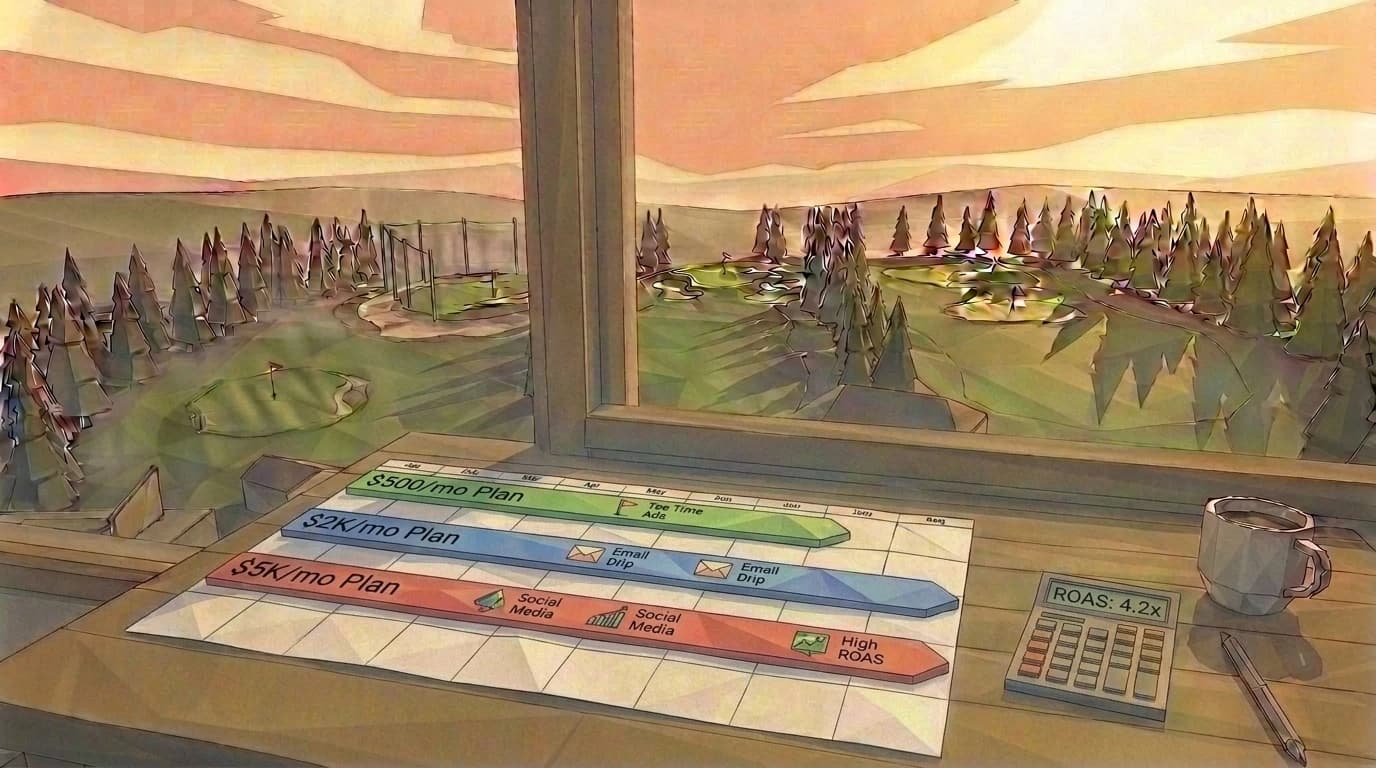
For the dual-budget version that applies the same sequencing logic at $500/mo solo-operator scale, see the 90-day ad plan with the budget math.
A note before the FAQ
We don't run a marketing agency for golf courses. We don't build their sites. golfcoachwebsites.com is a productized service for individual coaches — solo PGA pros, junior coaches, club instructors, and small academies. We wrote this list because we sat in on enough of those vendor presentations alongside coaches who'd been roped in. The ideas above are the ones that survived contact with actual P&Ls. The 6-to-stop list is where most courses can free up the budget to do the first list properly.
If any of these ideas involves a coach you employ — junior camps with a head pro, the women's twilight clinic, the corporate league taught by your teaching staff — the coach-side product is the part that handles their website and bookings without giving you another vendor to manage. For the pricing, our pricing page walks the math.
Frequently asked questions
Frequently asked questions
Email to your existing list — specifically an automated welcome flow plus a Thursday-2pm weekend special send. Hospitality benchmarks put open rates at 31-39% with 3-8% click-through, and Klaviyo's 2026 data shows automated flows produce 41% of email revenue from 5.3% of total sends. Cost: under $200/mo on most platforms. Payback: immediate, because the list already exists. The catch: most courses are running broadcast-only sends to a list that hasn't been cleaned, which is why the open rates look like 11%.
3-6% of revenue, with 50-65% of that going digital. A $1.5M-revenue public course should run roughly $4,000-$7,500 a month. Most we audit are at $2,000-$3,500/mo and underspending on what works. Within the budget, the channel split that closes the math is roughly 50% Google Search and GBP-influenced organic, 30% Meta retargeting, 10% email tooling, 10% experimental or partnership.
Indirectly. The signature hole video contest (idea #4) typically lifts bookings 8-12% over the contest window — but the lift is downstream, not direct from the contest itself. The mechanism is email list growth: contests generate signups, signups receive the welcome flow, the welcome flow drops a twilight-rate offer, the offer converts. If your welcome email isn't set up, the contest collects emails and then drops them on the floor.
Late February through April for spring/summer programs. Latest send to capture school-year decisions is around April 15th — after that, parents have made their summer plans. The high school partnership (idea #5) launches differently: outreach happens May for the fall season, with materials live by August so parents see them during back-to-school decision-making.
Both, but in order. First: complete the GBP and run Google Search Ads on branded plus 2-3 local commercial keywords. That's the fastest signal. Six months in, layer organic SEO content for long-tail queries ("[city] family-friendly golf course," "semi-private golf [region]"). Don't pay an SEO retainer before the GBP is complete — the SEO compounds against a broken foundation and you'll waste 6 months of retainer.
Yes — but only with regional micro-influencers (5K-50K followers), not big names. A $500-$2,000 partnership with a creator whose audience is in your market beats a $10,000 partnership with a national golf YouTuber for booking lift. The exception is luxury and resort courses where the destination story matters more than local conversion — those benefit from larger creators with travel-oriented audiences. For a mid-tier public course chasing weekday rounds, micro-influencer wins on every measurable dimension.
Last updated .
Keep reading