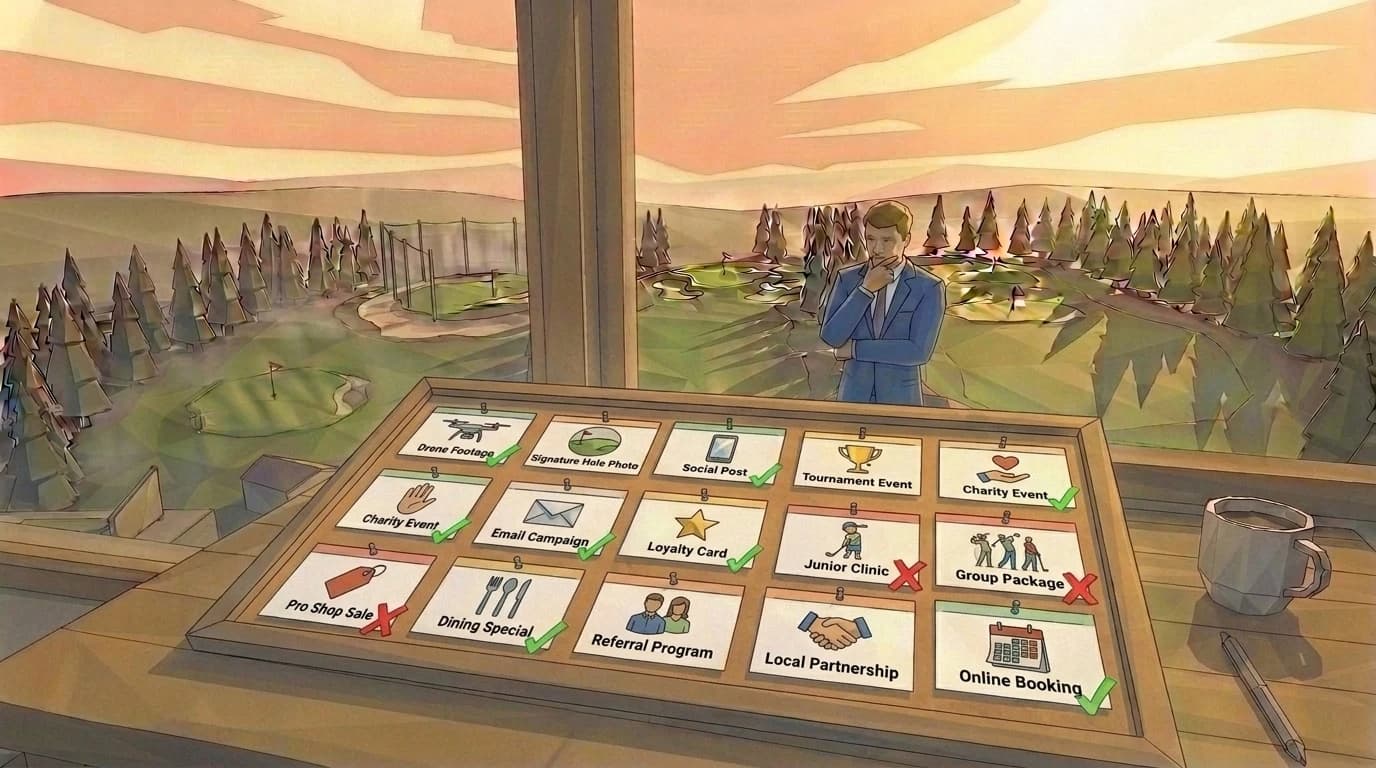
It's 2:14 on a Tuesday afternoon. Diane has the 2024 marketing plan open in Word. The board wants the 2026 version on Friday. She wrote the 2024 plan in late 2023 and barely remembers half of it. Page three lists "Goal: increase membership 10%" with no math under it. Page seven has eight bullets under "Channels" with the word "TBD" next to four of them. There is no budget. There is no calendar. There are no KPIs.
She knows what the board is going to ask. They're going to ask which line item produces which number. They're going to ask why marketing spend is up 8% and rounds are flat. The 2024 plan does not answer those questions and the 2026 plan needs to.
This is the version that answers them. Six sections, each tied to math that proves the plan is possible. A 90-day calendar with weekly accountability. Four KPIs, not 14. Sample budgets at $3K, $8K, and $25K monthly so the structure scales to your actual revenue.
Why most golf course marketing plans never get executed
The plan dies because nothing in it is falsifiable. "Increase membership 10%" is not a plan. It's a goal. A plan is the sequence of actions that proves the goal is possible at the budget you're willing to spend. Most golf course marketing plans skip the proving step entirely, which is why the plans get filed and the marketing spend continues looking the way it did the year before.
Below is the structure that works. Six sections. Each section produces a falsifiable claim. The plan reads like a memo, not a manifesto.
The 6 sections of a golf course marketing plan that actually works
- Situation analysis — the 8 numbers describing where you actually are right now.
- Goal definition with revenue math — what you're trying to move, by how much, and what it's worth.
- Audience segments — three groups, not seven.
- Channel allocation — the dollars-by-channel table at your specific budget.
- 90-day calendar — week-by-week activity, owner, and target metric.
- Measurement framework — 4 KPIs and the cadence to review them.
Skip any one of these and the plan starts losing structural integrity. Skip two and it's the 2024 doc Diane was looking at on Tuesday afternoon.
The situation analysis — the 8 numbers you need before you write a goal
You can't fix a number you haven't measured. Before the goal section, capture these 8 numbers — current state, not target state.
| Number | Where to get it | Industry benchmark |
|---|---|---|
| Annual rounds played | Tee sheet system (foreUP, Lightspeed, Club Caddie) | Public course capacity: 35K-55K rounds/yr |
| Tee time utilization (%) | Total booked / total available tee times | 65-75% public, 80%+ premium |
| Marketing spend (% of revenue) | Annual marketing line / annual revenue | 3-6% public, 2-4% private |
| Digital share of marketing spend | Digital channels / total marketing | 50-65% per NGCOA Modern Guide |
| Email list size + open rate | ESP dashboard (Mailchimp / Constant Contact / Klaviyo) | Active list 3K-15K, 31-39% open |
| GBP review count + avg rating | business.google.com dashboard | 100+ reviews, 4.4+ rating |
| ROAS (where measurable) | GA4 conversion attribution | 3:1 to 5:1 across channels |
| Member churn rate (private only) | Annual member exits / total members | 8-12% healthy, 15%+ problem |
The 8 numbers sit on the first page of the plan. Not the second. Not in an appendix. The first page. Everything downstream of this references back to one of these numbers.
The goal — and the math that proves it's possible
Skip the wish-language. Write the goal as: "Move number X from current value Y to target value Z, which produces $W in incremental revenue at cost $V."
Worked example. Diane's course is at 65% weekday utilization (number from the situation analysis). She wants to move to 70%. That's 5 percentage points of weekday tee times she's not currently filling.
Math. Course has 100 weekday tee times available per day × 5 weekdays × 30 weeks of in-season play = 15,000 weekday tee times annually. Currently filling 9,750 (65%). Target: 10,500 (70%). The gap is 750 incremental weekday rounds. At her $48 average green fee × $12 average cart fee × 0.85 group-of-3 multiplier = roughly $51 average revenue per incremental round. Total incremental revenue at goal: ~$38,250.
What can she spend to win those 750 rounds? Industry cost-per-booking benchmark is $3-8 online, so on the high end she could spend $6,000 to win 750 rounds and still make money. That gives her a marketing budget envelope: $0-$6,000 incremental annual spend allocated specifically to weekday-utilization moves. Above $6,000, the math stops working at her current cost-per-booking.
The goal section is now: "Move weekday utilization from 65% to 70% by Sept 30, generating $38,250 incremental revenue at allocated marketing spend of $6,000 (15.7% margin to operations)." That sentence is falsifiable. The board will know, at the next quarterly meeting, whether you closed the gap or didn't.
The audience segments — three groups, not seven
Most plans we audit have 7 audience segments. The marketing team can only execute against 3 well. Pick the 3.
For a public course, the three that earn the slots are usually:
- Members and regulars — the 70/30 retention focus. They generate 60-70% of revenue. They get email automation, weekday twilight emails, league communications, GBP review asks, and the loyalty program (if you have one).
- Local infrequent golfers (40-mile radius, 8-15 rounds/yr) — the acquisition target. They get paid Google Search, Meta retargeting, signature hole contests, and partner-channel promotions.
- Tourists or out-of-market golfers — the resort partnership channel. They get GolfNow exposure, hotel cross-promotions, and any travel-creator influencer plays. Cost per acquisition is higher but the average revenue per round is also higher.
If you're a private club, swap segment 3 for "prospective members" and structure the channel mix around membership tour scheduling rather than green-fee booking.
Most plans we audit have 7 audience segments. The marketing team can only execute against 3 well. Pick the 3. The other 4 segments will get marketing-by-spillover, which is fine — it's not the spillover that breaks plans. It's the dilution of attention.
The channel allocation table — at three budget tiers
Same structure. Three different budgets. Pick the row matching your actual spend, not the spend the board wishes you had.
| Channel | $3K/mo (small public) | $8K/mo (mid public) | $25K/mo (premium / private) |
|---|---|---|---|
| Google Search Ads | $1,200 (40%) | $2,800 (35%) | $7,500 (30%) |
| GBP management (time only) | $0 (4 hrs/mo internal) | $0 (8 hrs/mo internal) | $1,500 (agency / specialist) |
| Meta retargeting + Reels | $600 (20%) | $2,000 (25%) | $5,000 (20%) |
| Email platform + automation | $120 (4%) | $300 (4%) | $800 (3%) |
| Influencer / partnerships | $300 (10%) | $1,200 (15%) | $4,000 (16%) |
| Content / Reels production | $300 (10%) | $700 (9%) | $2,500 (10%) |
| Experimental / reserved | $480 (16%) | $1,000 (12%) | $3,700 (15%) |
| Total | $3,000 | $8,000 | $25,000 |
Notice the percentages aren't identical across tiers. The smaller budget concentrates on Google Search because it's the cheapest path to attribution. The larger budget can afford influencer and content production because the volume justifies it. Don't force a flat allocation across tiers — that's the mistake the cookie-cutter agency plans make.
For the deeper paid-vs-organic channel breakdown, see the paid + organic spend breakdown.
The 90-day calendar — week by week
Twelve weeks. Each row produces a target metric. Each row has a named owner.
| Week | Activity | Owner | Target metric |
|---|---|---|---|
| 1 | Situation analysis baseline (8 numbers locked) | GM | Numbers documented |
| 2 | GBP completion + first weekly Post | Marketing coord | Profile 100% complete |
| 3 | Email list cleanup + ESP audit | Marketing coord | List trimmed to engaged |
| 4 | Google Search Ads launch (branded + 2 local) | GM + agency | First clicks tracked |
| 5 | Welcome email automation live | Marketing coord | Flow live + first send |
| 6 | Thursday weekend email send #1 | Marketing coord | Open rate ≥ 28% |
| 7 | Meta retargeting Pixel verified, first campaign | GM | Pixel firing, audience built |
| 8 | First Reel published + cross-posted | Head pro + phone | Reel published |
| 9 | GA4 attribution audit | GM + agency | Cost per booking by channel |
| 10 | Kill underperforming channel + reallocate | GM | Budget reshuffled |
| 11 | Partner outreach: 1 charity + 1 corporate league | GM | 1 partnership pending |
| 12 | 90-day report + plan v2 draft | GM + board | Plan v2 reviewed |
This calendar isn't a download. It's the version that lives in the body of the plan you hand the board. Editable in whatever tool the board reads. The mistake most courses make is downloading a template, editing it once, and treating the download as the plan — the editable copy here is meant to be retyped into your own doc with your specific numbers in week 1 and week 9.
The measurement framework — 4 KPIs, not 14
Most plans track 12-15 KPIs, which means they track none of them well. Pick four. The rest are noise.
- Cost per round attributed to marketing — target $3-8. Calculated as marketing spend / incremental rounds traceable to a marketing channel via GA4 conversion event on the booking confirmation page.
- ROAS — target 3:1 to 5:1. Total marketing-attributed revenue / total marketing spend.
- Email list growth + open rate — target +3-5% list growth/mo, 31-39% open rate. List health is the single best leading indicator of future marketing efficacy.
- GBP weekly engagement count — target a baseline plus 10% MoM growth. Tracks calls, direction requests, and website clicks from your Google Business Profile.
Review cadence: the 4 KPIs sit at the top of the monthly marketing report. Everything else is appendix. If the board asks for a deeper number, the appendix has it. If they don't ask, you don't volunteer it. Marketing reports get long because the marketer is hedging — tighten the report and you tighten the thinking.
For the post that walks the dual-budget version of this plan with both course and coach examples, see the 90-day plan that works for any-budget course (or coach).
The cluster admission — and why the template stops here
You came here for a template. Here's the part that's going to feel like a bait-and-switch — we don't make the template available as a Word doc download. The template is the structure in this post. Copy it into whatever tool your board reads. We made that call because every downloadable template gets edited until it doesn't fit the situation anymore. Walking through this version once, with the math, will work better than a download you'll forget you have.
The larger admission, since this is the part of the post where we say it on every Cluster G piece. We don't build websites for full golf courses. We build them for the coaches who teach there. golfcoachwebsites.com is a productized service for solo PGA pros, junior coaches, club instructors, and small academies. If your plan involves making the coaches at your facility better-promoted — junior camps, head-pro lesson programs, women's clinic series — that part is what we directly do.
The team's full pricing math walks the productized $99/month coach-website economics. The website side of the marketing equation for the coaches at your course covers what we build and what it includes. For the 14-ideas-with-revenue-math version of this plan, see the marketing ideas list.
Diane finishes the plan by Friday morning. The board approves it Monday. The first GA4 attribution number lands in week 9. The first kill-decision happens in week 10. By the end of Q1 the report has shrunk from 22 pages to 6 and Diane stops dreading the quarterly meeting.
Frequently asked questions
Frequently asked questions
Six sections, in order: situation analysis (the 8 baseline numbers), goal definition with revenue math, three audience segments (not seven), channel allocation table at your actual budget, 90-day weekly calendar, and a 4-KPI measurement framework. Skip any one of these and the plan loses structural integrity. The most-skipped section is the goal math — most plans state goals without proving them possible.
Public courses: 3-6% of revenue. Private clubs: 2-4%. Within that envelope, 50-65% should go digital per the NGCOA Modern Guide. A $1.5M-revenue public course should run $45K-$90K annually. Most plans we audit are at 60% of where they should be — under-spending on email and GBP (which work) while feeling over-spent because the paid-ad attribution is broken (so the spend looks worse than it is).
Cost per round attributed to marketing. Target $3-8 online. It's the single number that ties marketing spend to rounds, which ties to revenue, which is the only thing the board cares about. Every other KPI — engagement, reach, impressions, follower count — is a leading indicator that's easy to game. Cost per round is hard to game because the booking either happened or it didn't.
Quarterly review of the calendar and KPIs. Annual rewrite of the situation analysis and goals. Don't rewrite the plan every quarter — that's churn, and quarterly rewrites usually mean the plan was too vague to commit to. The 12-week calendar gets a new version each quarter; the rest of the document stays mostly stable until annual planning.
Below $5K/mo total marketing spend, no — a marketing-fluent staffer plus 4-6 hours a month of GM oversight covers it. Between $5K and $15K/mo, a part-time or fractional marketer (or a boutique agency) starts to make sense. Above $15K/mo, an in-house marketing manager almost always wins on economics — loaded cost is around $5K-$7K/mo, and the institutional knowledge accumulates instead of leaving with the agency contact.
Yes, with two adjustments. Replace audience segment 3 (out-of-market tourists) with prospective members. Adjust the channel allocation toward member retention and prospect tour scheduling rather than green-fee acquisition. The 8 baseline numbers, the goal math structure, the 4 KPIs, and the 90-day calendar all apply identically. Member churn rate replaces tee-time utilization as the primary number on the situation analysis.
Last updated .
Keep reading