It's 11:42 on a Tuesday morning. Diane is on her fourth agency intro Zoom of the year. The agency partner is on slide 12 of a 22-slide deck titled "Bespoke Marketing Programs for Premier Golf Destinations." The slide visible right now has the words "synergistic" and "white-glove" on it. Diane has muted herself to take a slow breath. Three minutes left in the formal demo. Slides 13-22 still to come. The pricing slide is slide 19. She already knows what's going to be on it. She's already mentally written the email she'll send tomorrow declining.
This post is the version Diane wished existed in March, before agency #1. The named agencies in the golf marketing space, what each one actually charges, what each one is good at, and what each one quietly isn't. Plus the part nobody publishes — the 5 questions to ask any agency before signing, and when to skip the agency entirely.
We're not a golf marketing agency. We deliberately don't sell to courses. The honest comparison below is what we tell GMs who ask, and it's the same thing we tell coaches who get pitched by these same agencies for their academies.
The honest read on golf marketing agencies in 2026
Most "golf marketing agencies" you'll find on the first page of Google are 2-3 people with a website, a stock-photo hero image, and a portfolio of 4-6 logos that may or may not be active clients. That's not necessarily bad — small operators sometimes deliver better attention than big firms — but it's worth knowing what you're shopping in.
The big-name agencies (Hampton Golf, Cool Cat Marketing / Cool Club Marketing, Long Drive Agency) actually have specialized teams with golf-vertical experience. They're meaningfully different from a generic digital agency that lists "golf" as one of fifteen industries served.
Course management companies — Troon, Hampton, KemperSports — are a separate category entirely. They bundle marketing into ops, charge a percentage of revenue, and the marketing line is one of many. The economics work for some clubs and don't work for others; it's a structural decision, not a marketing decision.
The three categories of golf marketing service providers
| Category | Typical price | What's included | Best fit |
|---|---|---|---|
| Boutique digital agency | $1,500-$4,000/mo | Paid ads + social + maybe email | Small public, $1-2M revenue |
| Full-service golf agency | $4,000-$12,000/mo | Brand + web + ads + content + PR + events | Mid-large public, semi-private, multi-course |
| Course management company | Variable (% of revenue, often 4-6%) | Marketing bundled with operations + F&B + agronomy | Private clubs, distressed properties, multi-property portfolios |
Within each category, the named operators are different enough that "category fit" only gets you halfway. Below is the agency-by-agency breakdown.
The agency-by-agency comparison
Each row: specialty, typical client size, pricing model, strength, weakness. The pricing reflects what we've seen quoted across mid-Atlantic and Sunbelt clients in 2025-2026 — your market may vary by 15-25%.
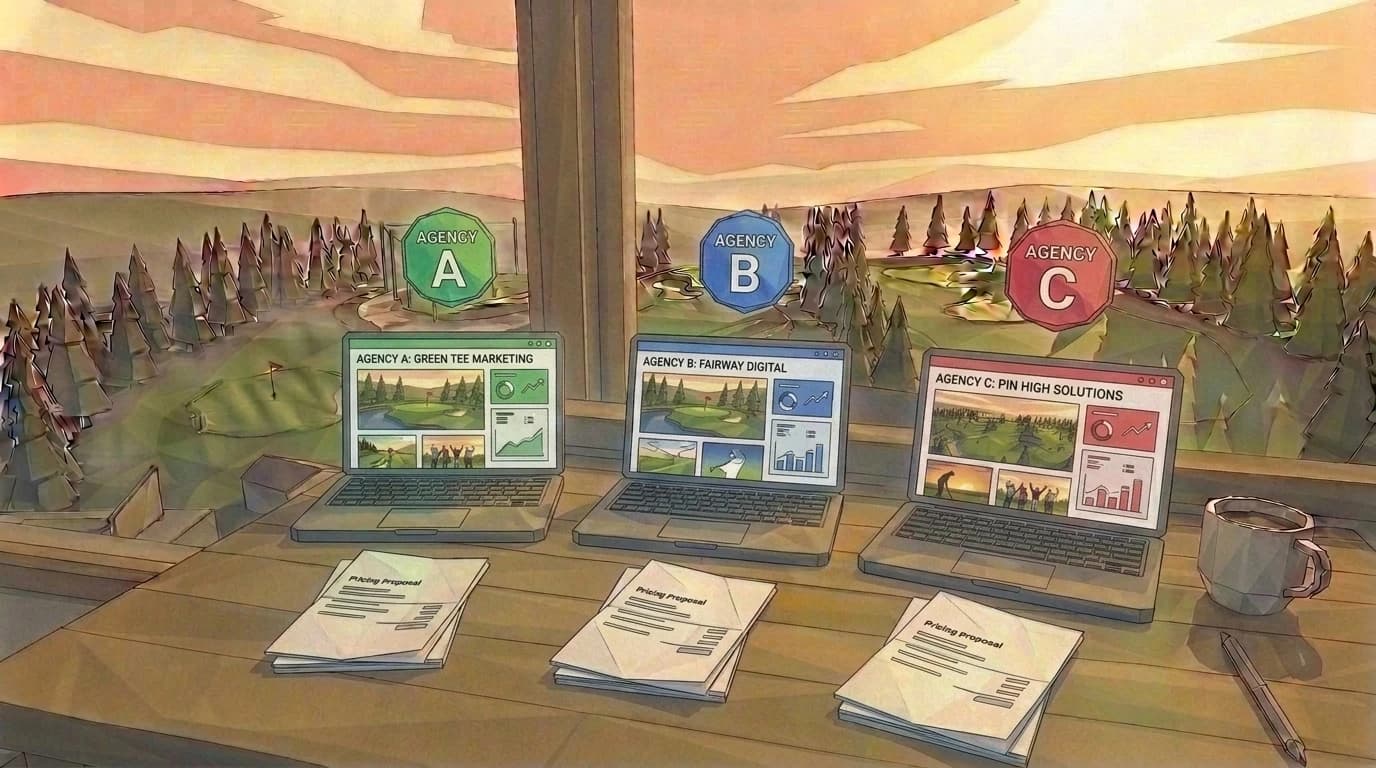
| Agency | Specialty | Client size | Pricing | Strength | Trade-off |
|---|---|---|---|---|---|
| Hampton Golf | Course mgmt + marketing bundled | Mid-large clubs | % of revenue (variable) | Operational depth, vertical fluency | Marketing isn't unbundled — you can't buy just marketing |
| Cool Cat Marketing / Cool Club | Country club focus | Private + semi-private | $3,000-$7,000/mo | Country-club brand fluency, member-comms experience | Less suited to public-course unit economics |
| Long Drive Agency | Country club + course marketing | Private + premium public | $3,500-$8,000/mo | Strong content team, named writers | Premium pricing relative to public-course economics |
| Creative Golf Marketing | Private club specialty | Private clubs | $4,000-$10,000/mo | Membership marketing depth, PR | Little public-course experience |
| Golf Space Collective | Broad golf agency, course-focused | Mid public + semi-private | $2,500-$6,000/mo | Course-side fluency, paid-ads competence | Smaller team — capacity ceilings |
| Trigger Digital | Content + ad management | Public + semi-private | $2,000-$5,000/mo | Tight content + ads pairing | Less brand / web depth |
| GolfBack Solutions | Revenue + marketing platform | Mid-large public | $1,500-$4,500/mo + platform fees | Tech + marketing integration | Platform lock-in concerns; harder to leave |
| Clubessential | Tech + marketing platform for private | Private clubs | $3,000-$10,000/mo platform-driven | Member portal + email integrated | Pricing scales hard with feature uptake |
| 1Digital Agency | Golf SEO specialty | Public + semi-private | $1,500-$3,500/mo | Search-vertical depth | SEO-heavy mix — paid ads weaker |
| TriMark Digital | Broader digital agency w/ golf vertical | Variable | $2,500-$8,000/mo | Strong digital fundamentals | Golf is one of multiple verticals — less specialization |
The agency pricing in the table is monthly retainer. Most agencies also charge ad spend pass-through (you pay them, they pay Google, plus a 10-20% markup) and project-based fees for things outside the retainer (rebrand, photo shoot, video production).
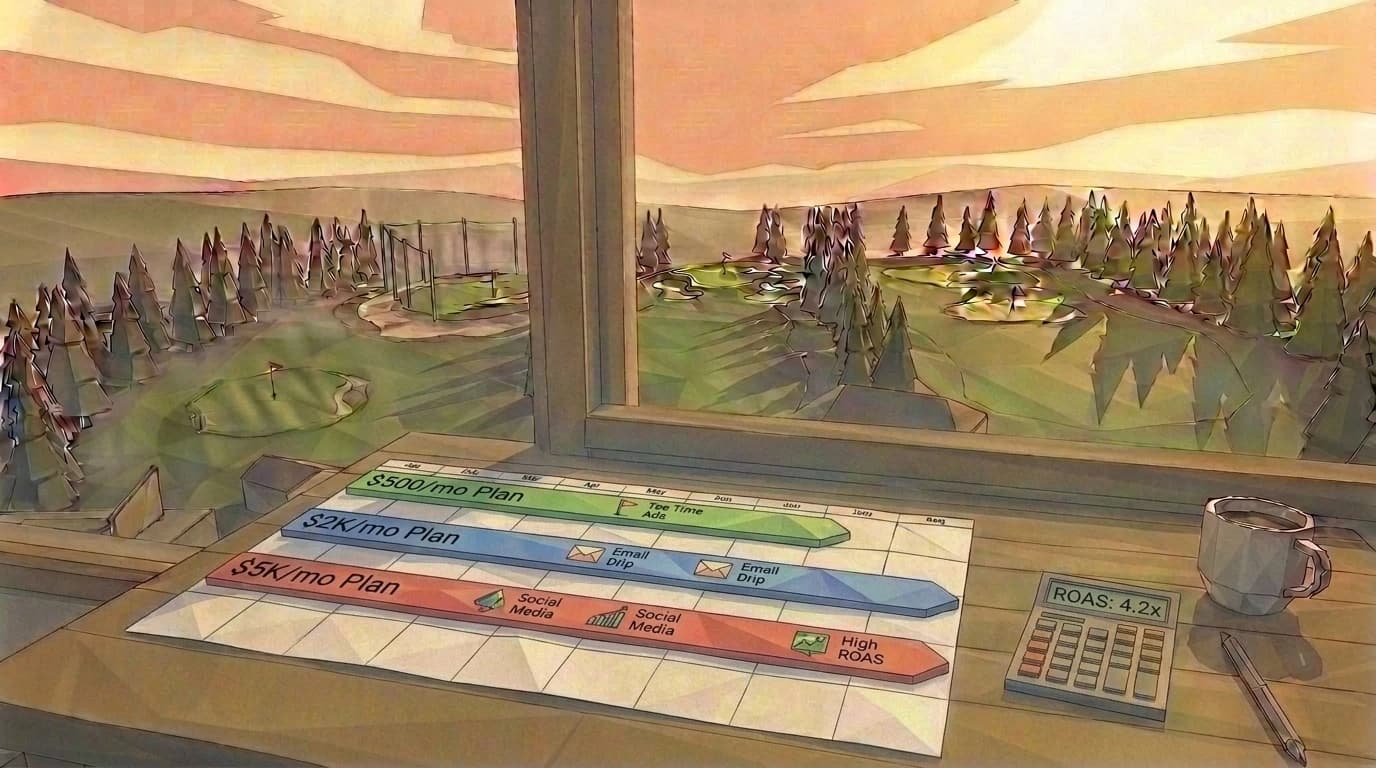
For the deeper "what each ad dollar buys you" version of this question, see the paid + organic spend breakdown. For the marketing plan you'd hand any of these agencies, see the marketing plan template you'd hand them.
In-house vs agency — the honest math
Boutique agency at $4K/mo = $48K/yr, plus ad spend pass-through markup, plus project fees. Realistic all-in: $60-80K/yr.
Loaded cost of in-house marketing manager: $55-85K/yr salary + benefits + software + ramp. Realistic all-in: $70-100K/yr.
The numbers look comparable. The structural difference: an in-house person accumulates institutional knowledge that stays. An agency contact rotates and the knowledge leaves. After 24 months, the in-house person knows your tee sheet patterns, your member quirks, your league schedule, your pro shop margins, your peak-season rhythm. The agency knows none of that as deeply.
Most courses with $3M+ revenue should consider in-house. Below $3M, an agency or fractional setup usually wins. The tipping point is when the marketing role gets too complex for an agency rotating contact and too cheap to justify a full-time hire — that gap is where fractional consultants ($1,500-$3,500/mo at 8-15 hours/week) often dominate both alternatives.
The in-house version isn't "hire someone full-time." It can be "promote a marketing-fluent existing staffer to half-time marketing manager and backfill their other half with a part-time hire." That structure usually closes the math at sub-$3M revenue better than the agency contract does.
The 5 questions to ask any golf agency before you sign
Tape these to the inside of your laptop. Ask all five. The agency that answers all five well is rare and worth keeping.
- Show me a client whose course is the same size as mine. If they can't, the experience doesn't transfer. Public-course paid-ad strategy doesn't work at private clubs and vice versa.
- What's your average client tenure? Twelve-plus months is good. Under six is a churn problem — find out why before becoming the next data point.
- Who specifically will be on my account? Names, not titles. The senior partner on the sales call is rarely the person doing the work. You want to meet the person doing the work before signing.
- How do you measure success? "Bookings attributed via GA4 conversion event" is the right answer. "Engagement, reach, impressions" is the wrong answer — those are leading indicators, not outcomes.
- What's the cancellation clause? Month-to-month is good. Twelve-month auto-renew with 90-day cancellation window is a red flag. The contract structure tells you whether the agency is confident in its retention.
When to skip the agency entirely
Three scenarios where the agency math doesn't close:
- Under $1M revenue. Probably skip. Use the budget on in-house tools (Google Ads + a basic email platform + GBP optimization in-house). The agency markup eats the budget at this scale.
- You have a marketing-fluent existing staffer. Buy them tools. Pay for a few hours of fractional consultant time monthly. Skip the agency. The staffer who knows your operation will outperform an agency that doesn't.
- You've worked with 2 agencies in 3 years and both disappointed. The problem isn't the agency. The problem is the brief. Rewrite the brief — be specific about goal, audience, channels, KPIs — and either find an agency that fits the brief or run it yourself with the same brief.
For the dual-budget version of the plan you'd run with or without an agency, see the 90-day plan you can run yourself instead.
A note before the FAQ
We're not a golf marketing agency. golfcoachwebsites.com is a productized website-and-maintenance service for individual golf coaches — solo PGA pros, junior coaches, club instructors, small academies. We're a sub-brand of Altitude Branding Co, which has done agency work for Golf Channel Academy, the LPGA, Troon, and PGA Tour coaches like Derek Uyeda and Chris Como. So we know the agency side well. We deliberately don't sell it to courses anymore.
The reason: the productized model only works at the unit-of-one level — one coach, one site, one monthly price, automated maintenance. The bespoke agency model works at the course/club level. Different product, different unit economics. We wrote this comparison because we sit next to GMs in client meetings and we'd rather they pick the right agency than a wrong one.
If you read this and realized half your problem is the coaches at your facility don't have proper websites, that part is what we directly do — see the productized version of agency work for individual coaches and the team's full pricing math.
Frequently asked questions
Frequently asked questions
Three tiers: boutique digital agencies at $1,500-$4,000/mo, full-service golf-specific agencies at $4,000-$12,000/mo, and course management bundles charging variable percentages of revenue (typically 4-6%). The boutique tier covers paid ads, social, and sometimes email. The full-service tier adds brand, web, content, PR, and events. The course management tier bundles marketing into operations and isn't a marketing-only buy.
Depends on the size. Under $2M revenue: skip the agency, run in-house with a fractional consultant. $2-5M: Trigger Digital, Golf Space Collective, GolfBack — all priced for public-course economics. $5M+: Hampton Golf or Long Drive Agency, with a real RFP comparing 2-3 finalists. The mistake is hiring a country-club agency (Cool Cat, Creative Golf Marketing) for public-course work — different unit economics, different audience, different mix of channels.
Golf-specific, in most cases. The vertical fluency saves you 6-12 months of education time — the agency already knows what tee-sheet integration looks like, how foreUP and Lightspeed differ, why GBP matters for golf in particular. A general digital agency at the same price will spend the first quarter ramping. The exception: if the general agency has a senior strategist with golf-vertical experience, the gap closes.
Paid ads: 30-60 days for first signal, 90 days for steady-state attribution. Email automation: 14-30 days once flows are live. SEO and content: 6-9 months minimum. The mistake to avoid is killing the engagement at month 3 — that's exactly when the data starts becoming actionable. Set a 6-month commitment, evaluate at 4 and 6 months, decide at month 6 whether to continue.
For distressed properties or owners who don't want to operate the club: yes, often. The bundle delivers operational discipline alongside marketing, and the marketing-only line is hard to evaluate inside the bundle. For healthy clubs with strong in-house operations: usually no — you're paying a percentage of revenue for marketing services you could buy unbundled at lower cost. The honest decision factor is your operations team's depth, not the marketing line.
Most golf marketing agencies aren't priced for solo coaches. The minimum retainers ($1,500-$4,000/mo) consume what a solo coach would spend on total marketing. The fit case: an academy with 4+ coaches and $500K+ revenue can absorb agency cost. Solo coaches usually win with fractional consulting + a productized website service like ours. We're not the only option in that space — but the unit economics of bespoke agency work don't bend down to solo-coach scale.
Last updated .
Keep reading