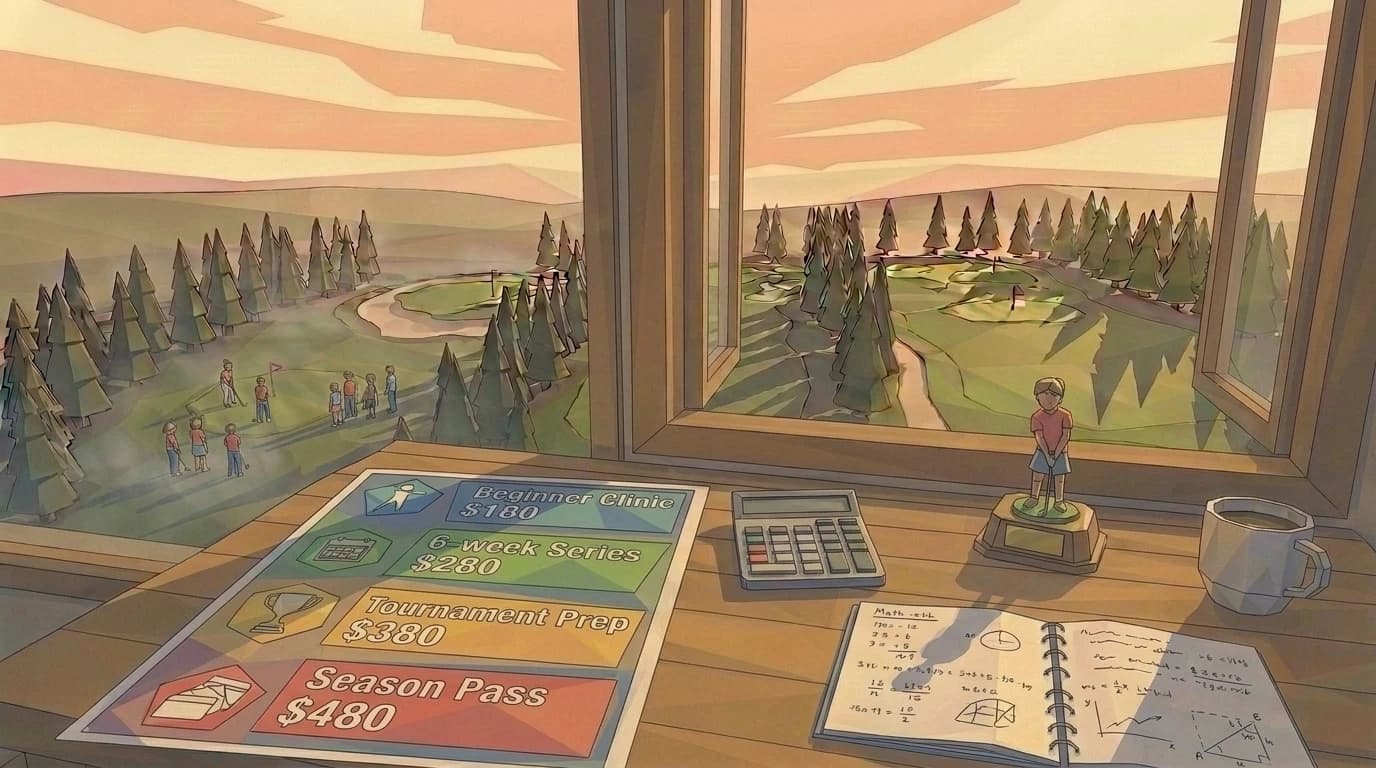
It's 10:15 on a Tuesday morning. Laura is on the range with a clipboard, a coffee that's gone cold for the second time, and a printout of last year's spring program schedule. She's trying to figure out three things at once: whether the spring program should be 6 weeks or 8, whether she should split the 9-year-olds from the 11-year-olds, and whether $180 was the right price last year or whether she should have charged $240 like the coach two towns over does.
The "figure it out" part is what every junior coach gets stuck on.
The "figure it out" part is what nobody publishes.
The 4 program-format families (and why "ideas" usually means picking the right family first)
When a coach asks for "junior program ideas," what they usually mean is something specific that sounds general. They don't need 30 new drills. They have plenty of drills. What they need is a structure — a format that fits the kids they have, the facility they have, and the hours they actually have available.
The format is upstream of the curriculum. Pick the right family first. The drills come later.
There are four families:
Clinics run weekly across a season. Camps compress into a few days. Leagues add competition and team structure. Season-passes turn the whole year into one product. Most coaches we've watched run 2 or 3 families in parallel — never all four, never just one.
The 17 formats below are organized by family. Each one has a session structure, an ideal kid count, a price range, and a use case.
Family 1 — clinics (formats 1-5)
Clinics are the workhorse. Recurring weekly, parents commit to a session count, you build skills across a season. Most solo coaches start here.
- The 6-week skill clinic. 6 sessions, 60-75 minutes each, 8-10 kids, $180-$300 per kid. Works for ages 8-13. The session structure: 10-minute warmup, 30 minutes on the skill of the week (full swing weeks 1-2, short game weeks 3-4, putting week 5, on-course rules and etiquette week 6), 15 minutes of small games, 5-minute closeout.
- The drop-in Saturday clinic. 1 session, 90 minutes, 12-16 kids, $35-$60 per kid. Works for ages 6-13 mixed. Best for coaches with a busy weekend range and no time for a multi-week commitment from parents. Margin is good. Predictability is bad.
- The 4-week themed clinic. 4 sessions, 60 minutes, 8 kids, $140-$200 per kid. Themes that work: "Get tournament-ready," "Learn the short game," "Build a swing from scratch." The shorter commitment converts parents who hesitate at 6 weeks. The smaller kid count justifies the higher per-kid price.
- The mixed-age 8-week clinic. 8 sessions, 60-75 minutes, 10-12 kids split into 2 skill groups, $280-$400 per kid. Works for facilities with two ranges or a range plus a putting green. The 8-week commitment is the longest most parents will agree to without season-pass framing.
- The after-school 10-week clinic. 10 sessions, 60 minutes, 10 kids, $300-$450 per kid, 4-6 PM weekdays. Works in cities with lots of after-school programming demand. Takes coordination with schools or community centers for pickup logistics.
The 6-week clinic is the format we see most. It hits the sweet spot of parent commitment (6 sessions feels manageable) and coach predictability (you know your spring revenue in week 2 instead of week 6).
Family 2 — camps (formats 6-10)
Camps compress into days, not weeks. They demand more facility time but they also generate the highest single-week revenue per coach hour.
- The spring break 3-day camp. 3 days, 3-4 hours per day, 12-16 kids, $180-$300 per kid. Runs during the local school district's spring break week. The rate-of-revenue here is the best in the calendar — three days of intensive can match a 6-week clinic in revenue.
- The summer week-long camp (half-day). 5 days, 4 hours per day, 12-16 kids, $300-$500 per kid. The classic format. Half-day camps have more parent demand than full-day because parents are pairing them with other camps in the same week.
- The summer week-long camp (full-day). 5 days, 6-7 hours per day with lunch break, 12-16 kids, $450-$750 per kid. Higher price, smaller demand pool — works best at academies with multiple coaches and indoor space for hot afternoons.
- The parent-and-kid weekend. 2 days, 3 hours per day, 6-8 kid+parent pairs, $200-$400 per pair. Newer format. Higher engagement, novelty appeal, harder to fill in markets without a strong existing junior community.
- The junior tournament prep camp. 3-5 days, 3-4 hours per day, 6-8 tournament-track kids, $400-$800 per kid. Premium pricing. The format is reserved for kids already playing or about to play in junior tournaments — not for beginners.
Summer camps are the second-most common format after clinics. They demand the most calendar coordination but they also generate the most revenue in the shortest window.
Family 3 — leagues + competition (formats 11-13)
Leagues add team structure and a season-long competition arc. Some coaches lean into them. Some coaches don't.
- The PGA Junior League local team. 8-week season, 8-player roster, 13U or 17U division, $120 PGA fee + $155-$380 local coaching fee. The franchise model. PGA Jr. League's "How it works" page has the full structure — 75,000+ kids nationally, 2-player scramble matches, regional postseason. The franchise-vs-independent comparison post walks through the tradeoff.
- The internal mini-league. 6-8 weeks, 12-24 kids on 4-6 teams, $220-$350 per kid. Your own version of a league at your facility. You set the rules, the format, the prize structure. The kids get the team uniform vibe without the franchise brand. The marketing burden is on you.
- The US Kids Local Tour entry coaching package. Tournament-series-aligned coaching, 4-8 weeks pre-tour, 4-6 tournament-track kids, $400-$650 per kid. Coaching package paired with the parent's separate Local Tour entry fees. Premium pricing because the parent is already invested in the tournament path.
Leagues fit some coaches naturally. They don't fit all coaches. The decision is partly about whether you want to coach competition and partly about whether your facility supports team formats.
Family 4 — season + membership (formats 14-17)
The longest commitment products. Higher revenue per parent. Harder to sell. Stickiest if you can sell them.
- The annual junior membership. 1-year commitment, $800-$1,500 per kid, includes priority signup for clinics + camps + leagues, plus 4-6 private lessons or playing lessons throughout the year. Works for established coaches with multi-program offerings. Below that, the membership doesn't have enough product behind it to justify the price.
- The semester-pricing model. Spring + fall as one bundled product, $400-$800 per kid for 12-16 sessions across 6 months with a built-in summer break. The semester framing parents already know from school converts at higher rates than a la carte clinic pricing.
- The parent-driven private package. 10 lessons, 45-60 minutes each, $500-$1,200 per kid. The private-lesson equivalent of a punch card. Works for kids who want one-on-one work but whose parents want predictable budgeting. The package discount is usually 8-12% off the per-lesson rate.
- The "I-coach-the-tournament-track-kid" private retainer. Monthly retainer, $400-$800 per month, includes weekly private lesson + tournament strategy support + range-time access. Reserved for the small number of kids on a serious tournament track. The retainer model converts these parents better than per-lesson pricing because the parent is buying ongoing relationship, not units.
Season-pass and membership formats sit on top of the other families. They don't replace clinics — they wrap around them.
For a deeper walk-through of the pricing math behind these tiers, the 4-tier pricing model post covers the per-session, package, season-pass, and membership math side by side. The marketing window for spring-launched programs is its own animal — the spring junior camp marketing playbook walks through the email sequence and landing-page structure for the Feb-April signup spike. And if the website you're going to push these programs through is the bottleneck, the pricing page covers the website-builder side of the math.
Frequently asked questions
Frequently asked questions
60-75 minutes for ages 6-9. 90 minutes for ages 10-13. The standard 6-week clinic runs 6 sessions of 60 minutes for $180-$300 per kid in most US markets. Below 60 minutes you're rushing the warmup and the closeout. Above 90 you're losing the younger kids' attention. The middle is where the math works for both coach and kid.
Clinic-style. You don't need range stations or a putting green dedicated to the program — a 4-station rotation works on any range with 8 bays. Camp formats need more space and more hours. League formats need team logistics. The 6-week clinic is the lowest-overhead format that still produces a real program — and it's the format we see launch first at most solo-coach facilities.
Don't split by age. Split by skill — beginner, intermediate, tournament-track. The 8-year-old who's been playing two years often plays at the same level as a 12-year-old beginner. Skill-grouping respects how kids actually learn the game and avoids the awkward dynamic of an experienced 8-year-old waiting through drills designed for new 11-year-olds. PGA Jr. League's age-blended division model is built on the same logic.
6-8 kids per coach for ages 4-7. 8-12 kids per coach for ages 8-13. Above 12 you need a second coach or you're babysitting, not teaching. Below 6 the per-kid revenue math gets thin unless you're charging premium prices. The 8-12 range hits the sweet spot — enough kids for group dynamics, few enough for real per-kid attention.
Yes — independent programs don't require certification. PGA Jr. League and First Tee chapter affiliation do require certifications or chapter membership for the head coach. An independent program needs students, a curriculum, a facility, and a website parents can find. The certification matters less than the program's reputation and the photos and testimonials on the page parents land on. See [the cluster pillar for the franchise-vs-independent comparison](/guides/junior-golf-programs).
Last updated .
Keep reading