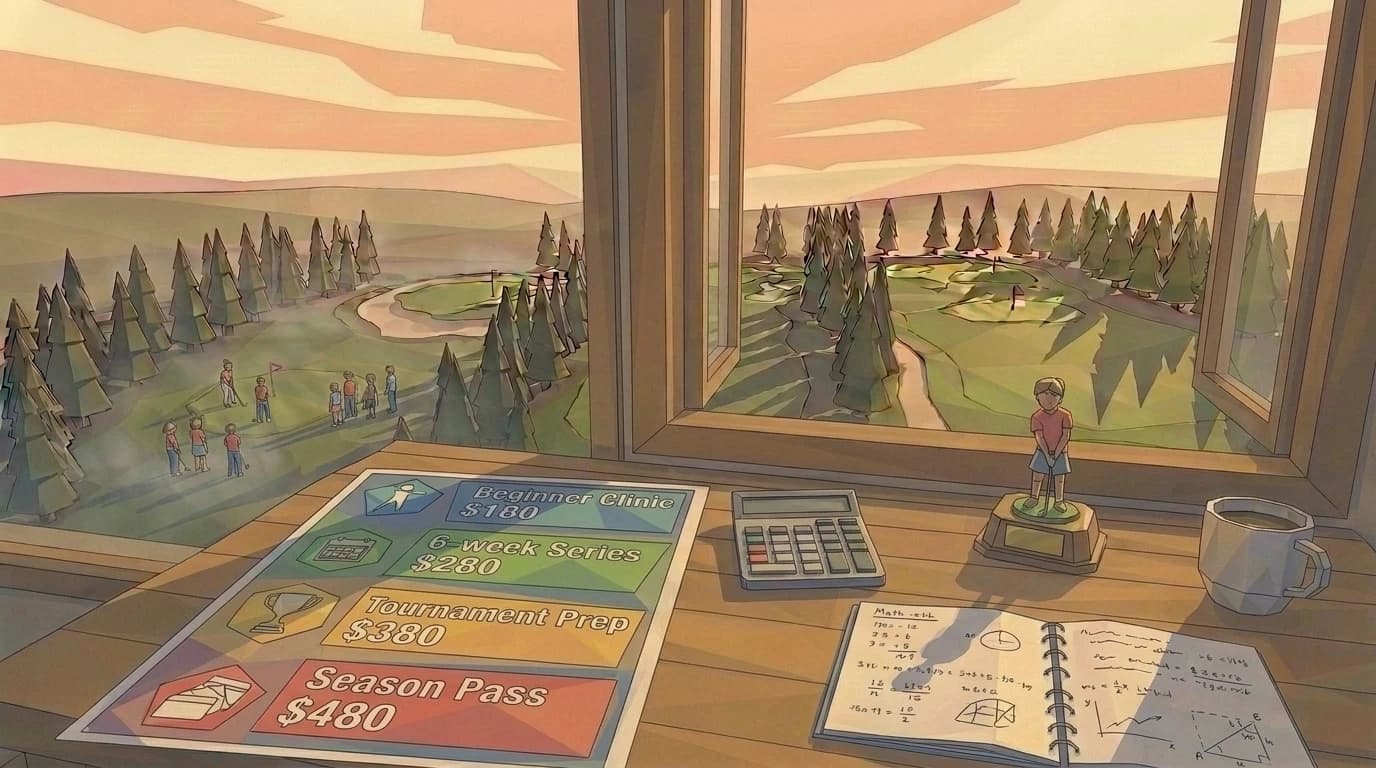
Laura's spring clinic price last year was $180 for 6 sessions. Three coaches she respects in nearby towns charge $240 for the same length program. She told herself she'd raise it next season. Next season is now. The page is open. Her finger is on the keyboard. The number she types changes how much spring revenue she sees, and she's still typing $180.
Most coaches type $180.
That's why this post exists.
The mistake — most coaches price by dividing the 1-on-1 rate
Here's the math we see most. A coach charges $90 for a 1-on-1 lesson. They run a junior clinic with 8 kids. They divide $90 by 8 to get $11.25 per kid. They round up to $15. The clinic is $15 a kid for 60 minutes. Six weeks of that is $90.
That's bad math.
A 1-on-1 lesson and a group clinic are different products. Different parent decisions. Different willingness to pay. Different competitive set. The 1-on-1 customer is buying focused expertise. The clinic customer is buying a structured program for their kid plus a social setting plus an outcome promise across multiple weeks.
The fix is pricing on the parent's "what's it worth" axis, not your hourly axis. What does a parent pay for a 6-week structured junior program with photos of last year's kids on the landing page and a clear curriculum? Per TeachMe.To's 2026 lesson cost report and the parent-facing price comparison data we've sampled, the answer in most US markets is $240-$300 for the median program — not $90.
The coach charging $90 isn't winning more kids. They're winning the same kids, who would also have paid $240 if the page named the right number.
The 4-tier model — per-session, package, season pass, membership
The four parent commitment levels:
- Per-session — parent commits to one drop-in. Lowest commitment, highest per-unit price.
- Package — parent commits to 6 sessions over 6 weeks. Standard middle tier.
- Season pass — parent commits to a 12-week season covering spring + fall or a similar bracket. Higher total revenue, longer commitment.
- Membership — parent commits to a year of access including multiple programs, priority signup, and ongoing privates. Highest total revenue, highest stickiness.
Each tier has a different price ceiling because each represents a different parent decision. The per-session parent is a price-shopper or a hesitant first-timer. The membership parent is buying the whole relationship for a year. They're not the same customer — and they don't pay the same way.
Most successful junior programs run 2-3 of these tiers in parallel. The 6-week package is the workhorse. The per-session option exists for drop-ins. The season pass and membership options exist for parents who already know they want the full year.
Tier 1 — per-session pricing ($25-$60)
Per-session pricing works for drop-in clinics, large facilities with steady walk-up traffic, or supplemental programming alongside a main package offering.
Pros:
- Lowest barrier to first booking — parents who hesitate at a 6-week commitment will try a single session.
- Highest per-unit margin — the per-session price is usually 15-25% higher than the same session-equivalent inside a package.
- Useful for filling slots when the package version isn't full.
Cons:
- No predictability — week-to-week kid count can swing wildly.
- Parents don't commit emotionally — they treat the session as one-off entertainment, not a program.
- Marketing burden is higher because every week is a new conversion conversation.
Decision rule: run per-session as a secondary offering if you have facility capacity, but don't make it your primary structure unless you have very high walk-up demand. The math for a 60-minute clinic with 10 kids at $40/kid is $400 in gross — solid for one session, but not a basis for a real program.
Tier 2 — package pricing ($180-$480 for 6 weeks)
Package pricing is the workhorse format. Six weeks, 6 sessions, fixed price for the whole package paid up front or in two installments. Parents commit. Coach gets predictable income. Both sides win.
The pricing range across markets:
- Lower-priced markets (smaller cities, public ranges): $180-$240 per kid for 6 weeks
- Median markets (urban-suburban): $240-$320 per kid for 6 weeks
- Higher-priced markets (Scottsdale, Westchester, Marin): $320-$480 per kid for 6 weeks
Most coaches are pricing in the lower-priced range even when their market is median or higher. The fix is checking three local coach prices and pricing in the upper third if your facility and reputation justify it.
The package math at $240/kid with 10 kids: $2,400 gross over 6 weeks. Subtract facility split (typical 25-30%): $1,680-$1,800 to the coach. Subtract your time (6 hours of teaching plus 2-3 hours of admin): the coach-hour rate lands at $187-$200 per hour. That's the floor. Below that, you're underpricing.
The discount math vs per-session: a $240 package for 6 sessions is $40/session, vs $50/session at the per-session rate ($60 ceiling, $40 floor). The 8-12% discount on the package converts parents who'd hesitate at per-session and gives the coach commitment in exchange.
Tier 3 + Tier 4 — season pass and annual membership
Season pass: 12-week bundled product covering spring + fall or summer + fall, $400-$800 per kid for 12 sessions. Works for the parent whose kid is already doing 6-week clinics and wants the price certainty of bundling. The discount vs two separate 6-week packages is usually 8-15%.
Annual membership: $800-$1,500 per kid per year, includes priority signup for clinics + camps + leagues, plus 4-6 private lessons or playing lessons spread throughout the year, plus range-time access.
The membership tier only works for established coaches with multi-program offerings. A coach running one spring clinic doesn't have enough product behind a membership to justify the price. A coach running spring clinic + summer camp + fall league + winter privates does. The membership wraps around the existing program structure — it doesn't replace it.
Below is the math across all four tiers, with a constant coach-hour rate of $400 pre-facility-split. The pattern shows what most coaches don't realize: the per-hour math is the same. The difference is parent commitment, program continuity, and total revenue per family.
| Tier | Format | Price per kid | Kid count | Total revenue | Coach hours | $/hour pre-facility | |---|---|---|---|---|---|---| | Per-session | Drop-in 60 min | $40 | 10 | $400 | 1 | $400 | | Package | 6-week clinic | $240 | 10 | $2,400 | 6 | $400 | | Season pass | 12-week season | $480 | 10 | $4,800 | 12 | $400 | | Membership | Annual + 3 programs | $1,200 | 10 | $12,000 | 30 | $400 |
The math holds across tiers — the coach-hour rate is constant at $400 pre-facility-split. The value-add of the higher tiers isn't a higher hourly rate. It's parent commitment, program continuity, and the LTV that compounds when a parent is buying a year instead of a session.
The full comparison of independent program economics vs PGA Jr. League — including the local-coaching-fee benchmarks for the franchise side — is in the franchise pricing comparison post. And the 17 program-format breakdown covers which formats fit which tiers.
The website-builder side of showing prices on the page itself — the load speed, the structured data, the mobile layout — is what the website pricing math covers. And for the broader confidence-in-pricing argument, the post on why we don't charge less than $99/month lays out the unit economics behind not underpricing. For the broader picture of how pricing fits into the full junior program design, the junior program playbook covers it end to end.
Frequently asked questions
Frequently asked questions
$180-$480 per kid is the national range, with $240-$300 the median for urban-suburban US markets. Source: TeachMe.To's 2026 Lesson Cost report and the parent-facing price comparison data we've sampled. Set yours by checking 3 local coach prices and pricing in the upper third if your facility and reputation justify it. Most coaches under-price by 20-30% relative to what their local market would pay.
10-15% off the second sibling is the norm. More than 15% trains parents to expect bigger discounts and erodes the price floor for everyone else. Some coaches we work with don't offer a sibling discount at all — they price the package fairly and skip the discount tier entirely. Both work. The 25-30% sibling discount most coaches default to is too aggressive and creates pricing-floor problems by year two.
$800-$1,500 annual for a coach with a real year-round program — spring clinic, summer camp, fall league, winter privates. Below that price, the membership doesn't have enough product behind it to be worth the parent's commitment. Above that, you need facility partnership benefits (range access, indoor practice space, priority booking) to justify the higher cost. The sweet spot for most multi-program coaches is $1,000-$1,200.
Yes. Hidden pricing on a coaching site is the single most common parent-bounce trigger we see in coach client analytics. Show the price. Parents who see a clear price either commit or self-select out — both outcomes are better than parents emailing you to ask, getting a delayed reply, and going somewhere with the price on the page. The unsure coach buries pricing. The confident coach names it on the page.
That's a marketing problem, not a price problem. PGA Jr. League charges $120 + local fee on top — the local fee alone runs $155-$380 per kid. Independent programs can match or beat the franchise total cost with a different product (more sessions, smaller groups, your name on the sign instead of PGA's). Don't price-match below the franchise just to compete on cost. Compete on the product.
Last updated .
Keep reading