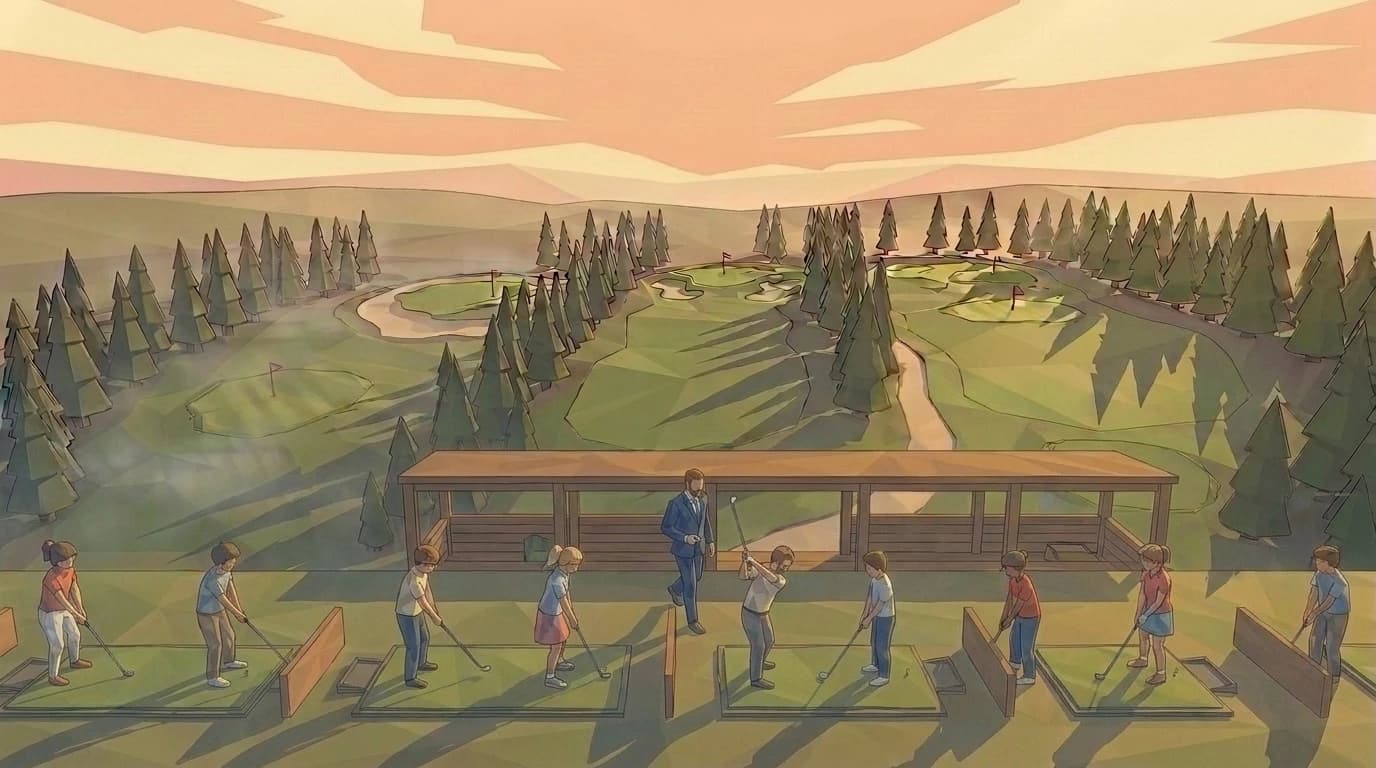
It's March 3rd. Laura's spring camp signup email is scheduled to go out at 8 AM tomorrow to four hundred and twelve parents she's built up over three seasons. It's 10:47 PM now. She's trying to rename the "Junior Tour Prep" page on her Squarespace from last year's title to this year's, and the header still says 2024 because the header is a separate block she can't find the edit panel for. Her coffee has been cold for an hour. She has three browser tabs open — Squarespace help forum, a YouTube tutorial from 2022, and her actual email draft with the button linking to the not-yet-renamed page. She's not going to finish. Tomorrow morning, four hundred parents are going to click a button that takes them to a page that says 2024.
She already knows.
Every junior coach who's built a program over multiple seasons has had this night. Some of them have it twice a year. Some of them learn from it and never have it again. The difference between the two camps isn't talent or technique. It's a system.
This is the system.
What a junior golf program actually is — the coach's definition
A junior golf program is a structured multi-session curriculum for golfers under 18, with a fixed start date, a fixed end date, a defined skill or age group, and a price set ahead of time. It is not the same as a one-off camp. It is not the same as a private lesson series. It is its own product with its own commercial logic.
The thing that makes a program a program is the structure. A one-off camp ends when the camp ends. A program runs across weeks, builds on what happened the week before, and ends with the kid in a different place than they started. Parents pay for the difference.
The curriculum is the part most coaches think about first. It's actually the part that matters least at the marketing decision. Parents don't read the curriculum before they sign up — they decide based on the photos, the price, the start date, and the testimonials. The curriculum is what makes them stay through the season and re-sign for the next one. It's the retention engine, not the acquisition engine.
The parent-communication system is the part most coaches under-invest in. A weekly text or email with a photo of the kid doing something specific — "Cooper made his first 30-yard chip into the green today, here's the video" — is the marketing move that wins next season's signup before the current season ends. The parent who got that text shows up to the spring camp email already half-decided.
The four real models — PGA Jr. League, First Tee, US Kids, independent
There are four meaningful program models a US junior coach picks between. Each one has a different parent-facing brand, a different cost structure, a different season shape, and a different fit for the coach.
| Dimension | PGA Jr. League | First Tee | US Kids Local Tour | Independent |
|---|---|---|---|---|
| Player annual fee | $120 (PGA registration) | $0-$110 (chapter) | $50/event entry | Coach sets |
| Coach cost | PGA membership + local affiliation | Chapter affiliation | Tour affiliation | Free |
| Season length | 8-10 weeks | Year-round | Tournament series | Coach sets |
| Curriculum | Provided | Provided | None (competition) | DIY |
| Brand recognition | High (parent search) | High (non-profit familiarity) | Medium (tournament-track families) | Low (built over years) |
| Coach margin | Medium (fee split) | Variable (chapter-dependent) | Coach earns lessons separately | High (no split) |
| Best for | PGA pros wanting structure | Coaches with non-profit alignment | Tournament-track families | Coaches who want full control |
PGA Jr. League is the franchise model. PGA Jr. League's "How it works" page lays out the full structure — 75,000+ kids nationally, 8-player rosters, 13U and 17U divisions, 2-player scramble matches, $120 player fee. The coach pays PGA membership and local league affiliation; the parent pays the $120 plus a separate local coaching fee that varies $155-$380 across leagues we've sampled. PGA Jr. League gives the coach brand recognition and a tested curriculum. It takes a fee split and your control over the curriculum.
First Tee is the non-profit network. The First Tee 2025 Annual Review reports 3.1M youth impacted annually across the chapter network. Chapters work differently from coach to coach — some pay coaches as employees, some pay flat fees per session, some run on volunteer instructors. If there's a First Tee chapter in your area and your teaching philosophy aligns with the non-profit's character-development focus, it's a viable model.
US Kids Golf Local Tour is the tournament-track model. Not a coaching league — a tournament series. Coaches who run "Local Tour entry coaching" packages help kids prepare for the tour events but earn through their own private-lesson fees, not through the tour itself. Best for coaches working with tournament-track families.
Independent is the coach-owns-everything model. You design the curriculum, set the price, build the brand, run the marketing. The margin is highest. The marketing burden is highest. The franchise-vs-independent comparison post walks through the decision in detail.
The economics — what coaches actually charge in 2026
The price range for a 6-week junior clinic in 2026 across US markets:
- Lower-priced markets: $180-$240 per kid for 6 weeks
- Median markets: $240-$320 per kid for 6 weeks
- Higher-priced markets: $320-$480 per kid for 6 weeks
Per TeachMe.To's 2026 lesson cost report, per-session group clinic pricing runs $25-$60 per kid per session, with $35-$45 the median. Private junior lessons run $50-$150 per 45-60 minute session.
The 4 pricing models a coach chooses between:
- Per-session pricing. $25-$60 per kid per session. Drop-in clinic format. Highest per-unit price, lowest commitment, lowest predictability for the coach.
- Package pricing. $180-$480 for 6 weeks. The workhorse format. 6 sessions sold as one package, paid up front or in two installments. Predictable revenue. Strong parent commitment. The format most successful coaches build their season around.
- Season pass. $400-$800 for 12 weeks across spring + fall or similar. Bundled product. Higher total revenue per family. Discount of 8-15% vs two separate 6-week packages.
- Annual membership. $800-$1,500 per year. Multi-program access plus priority signup plus 4-6 private lessons. Works only for established coaches with a real year-round program structure.
The math that has to work for a 6-week clinic at $40/kid with 10 kids and a 30% facility split: $2,400 gross, $1,680 to the coach across 6 hours of teaching and 2-3 hours of admin. That's $187-$200 per coach-hour. Below that, you're underpricing. Most coaches we've audited are at $25-$30/kid for the same format and clearing $130-$150/coach-hour without realizing they could charge 30% more.
The 4-tier pricing model post walks through each tier in detail with the math behind every price point.
The Laura playbook — designing your first program from scratch
If you're starting from zero and you're going to run one program in spring 2027, here's the structure that works.
A 6-week clinic. Six sessions, 60-75 minutes each, 8-12 kids, ages 8-13 split into beginner and intermediate groups. Tuesdays at 4:30 PM works for most after-school markets — pick whichever weekday afternoon your facility has range time and your families can drive to.
The week-by-week curriculum that we've watched land:
- Week 1 — Setup and the full swing. Grip, stance, alignment, ball position. The kids who've never held a club get the basics. The kids who've been playing get a setup audit. End the session with each kid hitting 5 balls on video. Send the videos to parents the same night.
- Week 2 — Full swing continued, plus the first short-game work. Continue the swing focus from week 1. Add 20 minutes of chipping fundamentals — landing zone, basic bump-and-run, the difference between a chip and a pitch. Most kids have never been taught the difference.
- Week 3 — Putting. Full session on putting. Distance control first, line second. Use a tape ladder on the practice green to teach distance with feet, not feel. End with a putting contest — small prize, big enthusiasm.
- Week 4 — Mixed drills. Station rotation: full swing station, chipping station, putting station, target-game station. 12-15 minutes per station. Kids see how the parts fit together. Coaches see who's progressing where.
- Week 5 — On-course rules and etiquette. If your facility has a short course or a few holes, get the kids on actual grass. Cover ready-golf, marking the ball, who putts first, what to do when you hit it in the woods. Most kids learn rules from older players or YouTube — neither is reliable.
- Week 6 — Skills test and fun day. Closing session. Run through 5-6 skill stations with scoring. Award certificates. Take a group photo for the parents and for next year's marketing.
The structure works for ages 8-13. Younger kids (4-7) need shorter sessions, more games, less swing detail. Older kids (14-17) need more on-course work and less drill repetition. The 17-format breakdown post covers age-specific variations.
How to handle mixed-skill groups: split by skill, not by age. The 8-year-old who's been playing two seasons often plays at the same level as a 12-year-old beginner. PGA Jr. League runs the same logic — their 13U bracket is age-blended, with skill grouping inside the bracket. The "tee yard" model some coaches run is the same idea: kids split into 2-3 groups based on skill, rotate through the same drills at appropriate progressions.
Signups happen in February — the spring camp marketing window
The peak signup window for May-June junior camps is February through early April, with 80% of signups concentrated in those 10 weeks. Miss the window and you fill the camp on word-of-mouth alone — usually at 60-70% capacity at lower margins.
It's March 3rd. Laura's spring camp signup email is scheduled to go out at 8 AM tomorrow to four hundred and twelve parents she's built up over three seasons. It's 10:47 PM now. She's trying to rename the "Junior Tour Prep" page on her Squarespace from last year's title to this year's. The coffee has been cold for an hour. She already knows.
That's the version every coach starts in. The fix is upstream — the spring schedule needs to be on the website by January 10th and the first email needs to go out the second week of January.
The list is the asset. Last year's parents are 80% of this year's signups for established coaches. New coaches without a list are catching up across one season — building a list this spring so next spring runs differently.
The 5-email sequence (full version in the spring marketing playbook):
- Email 1, Jan 13: "Spring lineup is ready" — schedule drops, link to landing page
- Email 2, Jan 27: "Returning families get first pick" — first-pick window for last year's parents until Feb 4
- Email 3, Feb 12: "Spots are filling" — social proof email, real numbers ("12 of 24 spots gone")
- Email 4, Feb 26: "Final reminders" — segment-specific last-week emails by program
- Email 5, Mar 12: "Last call / waitlist" — the most-skipped email and the one that books Phase 3 panic parents
The PGA Jr. League registration cycle confirms the same window — PGA Jr. League's player registration announcement opens in late November, but actual parent signups cluster in February-April for both franchise and independent programs.
The website piece — what parents actually click on
The parent decision flow looks like this. Mom searches "junior golf lessons [your city]" or "junior golf camp [your city]" at 9 PM on a Tuesday after the kids are in bed. Three results show up in the local pack. She taps your name. The page loads. She has 8 seconds to decide if your program is for her kid.
The 6 elements above the fold — visible without scrolling on a phone:
- Start date. "Spring 6-week clinic — starts April 7."
- End date. "Ends May 12."
- Age range. "Ages 8-13, split into beginner and intermediate groups."
- Price. "$240 per kid, paid up front or in two installments."
- Photos of last year's kids. Real ones, with parent consent on file. Not stock.
- One-step signup. Name, email, kid's age, group selection. Not a 4-step flow that asks for everything before showing the price.
Bury any of these and the parent bounces. Show all of them and the parent who already decided to pay finds it easy to commit.
The website itself is roughly 30% of the parent decision. The other 70% is the in-person feel of the first session — whether the kid wants to come back — and the photos in the parent's text thread to other parents the next day. Both halves matter. The website's job is to win the click and not lose it. The in-person job is to win the season and the next one.
The local-search piece for parents searching at 9 PM is what fills the local pack with your name in the first place. The website is what closes them after the click.
Photography for junior programs — the parent-trust signal
The single biggest difference between a junior-program landing page that converts and one that doesn't is the photos. Real photos of last year's kids beat any other element on the page.
What counts as a usable photo:
- Kids' faces visible (or intentionally angled away — both work depending on parent consent)
- Parent consent on file for every identifiable kid
- At-the-range or on-the-green backdrop — not generic outdoor scenes
- The coach in some of them, not all
- A mix of action shots, feedback moments, and group photos
The 12-photo minimum for a junior-program landing page: 3 group shots, 3 action shots, 3 feedback moments, 3 outcome photos (kid hitting first driver, kid holding tournament trophy, group certificate moment).
The "no stock photos" rule applies more strictly to junior programs than to adult programs. Parents booking for kids are more cautious — they're checking whether the program is real, whether other parents trust it, whether the photos look like a place they'd send their own kid. Stock photos kill that signal in seconds.
The photo strategy for junior programs covers the consent forms, the 5-shot framework, and the no-stock rule in detail. The strategy is the same for solo coaches and academies. The volume of photos is what scales.
For coaches running both junior and adult programs on one website, the structure for two audiences covers how to position both without one undermining the other. And the website infrastructure that supports the whole junior-program operation is what the website-builder pillar walks through — including what the website side actually costs.
Frequently asked questions
Frequently asked questions
A structured multi-session curriculum for golfers under 18, with a fixed start and end date, a price set ahead of time, and a defined skill or age group. Not the same as a one-off camp. Not the same as a private lesson series. The structure across multiple weeks is what makes it a program — a parent paying for a program is paying for the difference between where their kid started and where they ended up.
Most coaches run programs starting at age 4-5 with US Kids-style oversized clubs. Lessons stick at age 6-7 with most kids — they have the attention span and motor control to engage with real instruction. PGA Jr. League starts at 13U (which includes ages 4-13 in many divisions). Earlier than 4-5 is fine if the kid asked first. Forcing a 3-year-old who didn't ask to take lessons usually doesn't end well.
Group clinics run $25-$60 per session, with $35-$45 the median. A 6-week program runs $180-$480 across markets, with $240-$300 the median for urban-suburban US. Private lessons run $50-$150 per 45-60 minute session. Source: TeachMe.To's 2026 Lesson Cost report. Most coaches under-price by 20-30% relative to what their local market would pay.
PGA Jr. League is a franchised league with national branding, a $120 player fee paid to PGA of America, and a defined team format (8-player rosters, 2-player scramble matches). Independent programs let the coach own the brand, the curriculum, and the full margin — but the marketing is on you. PGA Jr. League is the faster path for a coach without an existing list. Independent is the higher-margin path for a coach with one.
Three inputs. What local PGA Jr. League charges (your benchmark ceiling — $275-$500 total parent cost). What your facility costs you per session. How many kids you can teach at once. The 6-week math: 6 sessions × 10 kids × $40 = $2,400 gross, minus facility split, minus your prep and admin time. If your coach-hour rate after that comes out below $180-$200, you're underpriced. Most coaches are.
February through early April for May-June camps. June-July for late-summer camps. The first email blast that converts is the one that goes out the second week of January, when last year's parents are looking ahead. Schedule drops on the website by January 10. First email goes out January 13. Parents who didn't see the schedule by mid-January are not in the high-conversion pool when they finally do.
No. PGA Jr. League requires PGA or LPGA membership for the head coach. First Tee requires chapter affiliation. An independent program needs no certification — it needs students, a curriculum, a facility, and a website parents can find. Certification matters for credibility in some markets and not in others. The reputation built across years of well-run programs matters more than any single certification.
Show the start date, end date, age range, price, photos of last year's kids, and a one-step signup — all visible without scrolling on a phone. Most coach websites bury this on a third-level page parents never reach. The 6 above-the-fold elements close the parent who already clicked. Bury any of them and the bounce rate spikes. Show all of them and the parent who decided to pay finds it easy to.
The closing scene
It's March 3rd next year. Laura's spring camp signup email goes out at 8 AM. The schedule has been on the site since January 10. The first email of the sequence went out January 13. The third one — the "12 of 24 spots gone" social proof email — went out three weeks ago. The fifth one will go out next week to confirm the waitlist.
The page header says 2027.
The coffee on the desk is still warm.
That's the version we wrote this for.
Last updated .