David did the website search the morning after the brother-in-law moment. He found his Google Business Profile buried under "people also viewed." Seven reviews. The most recent one was from 2023. The profile photo was a club staff page screenshot, not a picture of him. He stared at the screen on his desk for about a minute. He didn't fix anything that morning. He fixed it three weeks later, after a member's wife forwarded him a Whitespark blog post with a sentence underlined in yellow highlighter.
The underlined sentence was about prominence.
That's what this post is about.
Prominence — the one factor you can actually move
Google's local pack runs on three signals. The order they're listed in Google's own help documentation is relevance, distance, prominence. Two of those three are mostly fixed for a coach.
Distance is fixed because your range is where it is. You can't pick up a public range and move it 600 yards closer to the searcher. You can set your service area to expand the radius Google considers, but the physical anchor is what it is. Don't fight that.
Relevance is mostly fixed by your primary GBP category. Pick "Golf instructor" — the right one — and your relevance for "golf lessons," "golf coach," "golf instructor," and the variants is set. Pick "Sports school" and you're competing against tennis academies and gymnastics studios. Most coaches who rank poorly for "golf lessons [city]" picked the wrong primary category three years ago and never changed it. That's the first fix.
Prominence is where the work pays off. It's the only signal you can move significantly through effort.
The good news is that "prominence" sounds vague but breaks down into four quantifiable inputs once you read Google's documentation carefully. The bad news is most coaches under-invest in the one that compounds the fastest.
What "prominence" actually is in Google's documentation
Here's Google's exact language. Prominence is "how well-known a business is" — measured through review count, review score, links from articles or other websites, and "the business's general standing offline." That last phrase is intentionally vague. Google won't tell you exactly what counts as offline standing, which is fine because the parts that aren't vague are the parts you can actually move.
The four quantifiable inputs to prominence:
- Review count and review score. How many Google reviews you have, and what your average rating is. A 5.0 with 4 reviews ranks below a 4.6 with 28 reviews in most markets. Volume signals trust at scale. Score signals trust per data point.
- Review recency. When the most recent review was posted. A profile with 30 reviews from 2022 looks dormant. A profile with 12 reviews where the last one was three weeks ago looks active.
- Photos and posts. Activity on the profile itself — uploading new photos, publishing GBP Posts during signup or marketing windows. This is the "active profile" signal that compounds with reviews.
- Inbound links. Links to your website or your GBP from other websites — the chamber of commerce, the range you teach at, a local junior tournament, a parent blog. These are harder to get than reviews and harder to lose.
Those four are what you optimize. Everything else in the prominence calculation is either out of your control or low-leverage relative to the four above.
Reviews — the prominence input that compounds
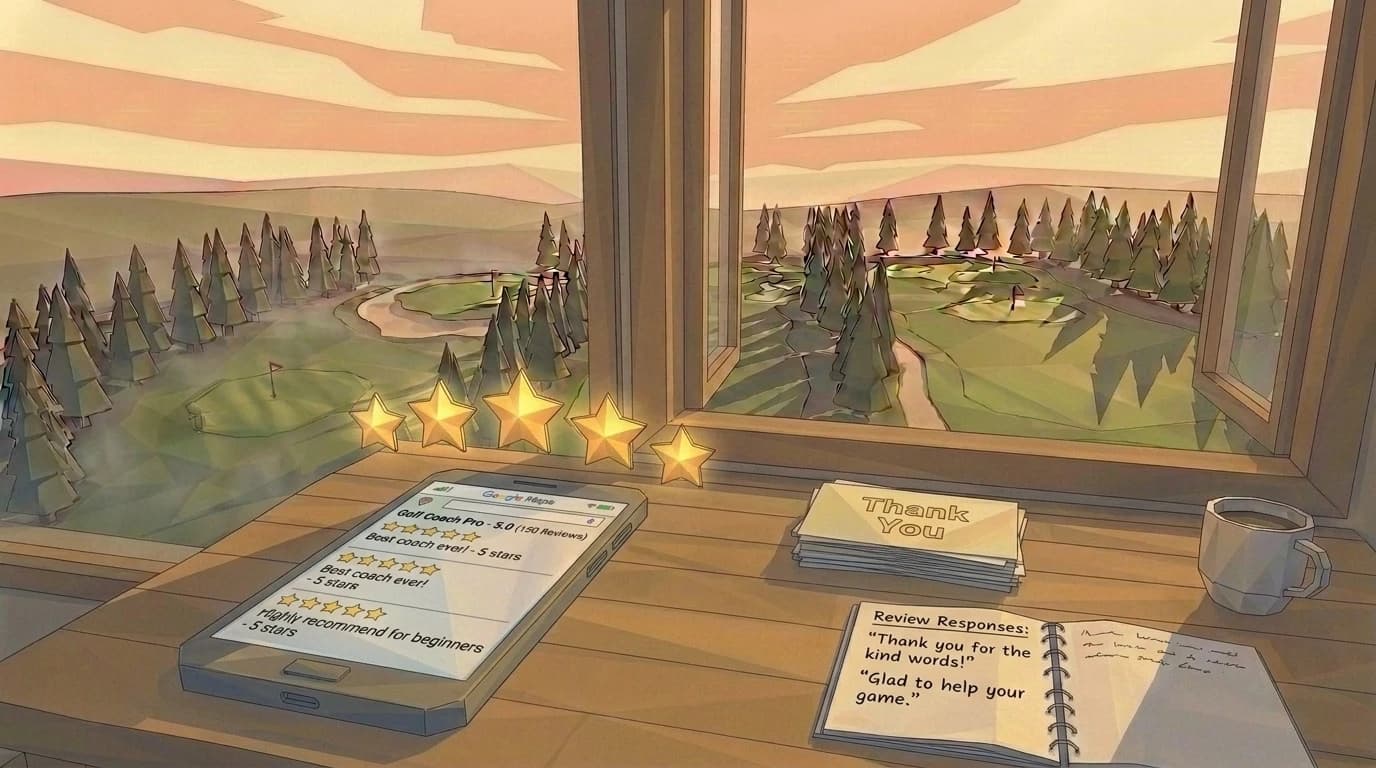
If you only have time for one prominence input, this is it. Reviews are 20% of the local pack per Whitespark's 2026 Local Search Ranking Factors — second only to GBP signals themselves. They compound because each new review increases your visibility, which increases your bookings, which increases your supply of students who could leave the next review.
20 is the trust floor. BrightLocal's 2026 Local Consumer Review Survey found that 47% of consumers won't use a business with fewer than 20 reviews. Below that number, parents read your profile as a hobbyist, not a working coach. You don't need 200. You need 20+ with a steady drip of new ones.
Recency matters almost as much as count. The same BrightLocal survey found 45% of consumers prioritize reviews from the last three months. A profile with 50 reviews where the last one was 18 months ago reads worse to a parent than a profile with 22 reviews where the last one was last week. The recency signal also feeds Google's freshness check on your profile.
The response habit is the third piece. Respond to every review — positive and negative — within 24 hours for negatives, within a week for positives. Google indexes the responses. Mentioning what you teach and where, naturally, in a thank-you reply ("Thanks for the kind words about the junior swing fundamentals work at Desert Springs") is a small but real SEO signal. More importantly, 97% of consumers read review responses. The reply isn't for the reviewer — it's for the next parent reading the page.
Photos and posts — the freshness signals
Photos are the under-used input. Google's own published data shows profiles with photos get 42% more direction requests and 35% more website click-throughs than profiles without. Most coach profiles have fewer than 10 photos. That's the lowest-effort, highest-impact fix on the list.
Here's the photo and post calendar that works for a solo coach:
- Initial upload — 12 to 15 photos. A range action shot, a feedback moment with a student looking at a phone, a group junior clinic line, a headshot of you at the range, a photo of the entrance sign or the bay you teach in, two or three swing-instruction angles, and a couple of "outcome" photos — a kid holding a junior tournament trophy, a milestone moment.
- Monthly cadence — 1 to 2 new photos. Pick the same Tuesday morning every month. Spend 15 minutes uploading photos from the prior four weeks. The "active profile" signal Google watches for is satisfied by this rhythm.
- Posts during signup or marketing windows — weekly. Spring camp registration window, summer clinic announcement, fall junior league signup. GBP Posts have a 1,500-character limit and stay live indefinitely (Google removed the 7-day expiration in 2023). One post a week during your active marketing window is the right cadence.
- Posts off-window — monthly. When you're not actively recruiting, one post a month is enough to keep the freshness signal alive. Don't over-post — the empty-content trap is real.
The photo strategy is something we cover in more depth in the lesson photography post — including the consent forms for junior photos and the no-stock-photos rule that applies as much to GBP as to your website.
Links and citations — the offline prominence piece
Google's "general standing offline" language hides what's mostly an inbound-link signal. The links and citations worth chasing for a coach are smaller than the SEO blogs make them sound. Here's the realistic priority list — by effort and impact.
| Source | Effort | Impact |
|---|---|---|
| Google Business Profile (already have) | — | — |
| Apple Maps Connect listing | 30 min | High — Apple Maps drives a meaningful share of "near me" searches on iPhones. |
| Bing Places for Business | 30 min | Medium — fewer searchers, but the citation signal feeds Google's confidence in your business as a real entity. |
| Facebook Business Page (cleaned up) | 30 min | Medium — most coaches already have one; the fix is making sure the address, hours, and phone match GBP exactly. |
| Local chamber of commerce listing | 1 hr + $50-200 fee | Medium — one inbound link from a respected local domain. Worth it in most markets. |
| Range or facility website backlink | Email + relationship | High — if the range you teach at links to your site from their staff page or instructor list, that's the highest-value local link you can get. |
| Local junior tournament site backlink | 2-3 weeks (relationship) | High — junior tournament sites often list local coaches as resources. Reach out before tournament season. |
| Paid backlink schemes | — | Negative — Google penalizes these. Don't. |
The total effort for the legitimate citation cleanup is about three hours. The chamber-and-range step takes a phone call and a follow-up email. None of this requires a budget.
What you don't do: buy backlinks. The 2026 Google Spam Update and the related core updates have penalized paid-link patterns harder than any time in the last decade. If an agency offers you "1,000 high-DA backlinks for $400," they're either lying about the links or selling you a manual penalty. Don't.
The website-side of the prominence equation is where the GBP click closes. The pricing page lays out what the site itself costs — and how the site, the GBP, and the citations fit into the same machine.
Frequently asked questions
Frequently asked questions
Google's stated description: a measure of how well-known a business is, based on review count, review score, links to your website, articles about the business, and the business's general standing offline. Coaches can move review counts, recency, photos, posts, and inbound links. Offline standing is harder to game directly. The four quantifiable inputs are where the work pays off.
Most coaches see measurable movement in 60-90 days when they fix the GBP basics, get from 5 to 20+ reviews, and add monthly photo activity. Faster movement (under 60 days) requires also addressing on-page signals on the website — title tag, H1, LocalBusiness schema, sub-1.5 second load time. The compounding part — where each new review brings new bookings which bring new reviews — kicks in around month four or five for most coaches.
Yes. Google's own data shows profiles with photos get 42% more direction requests and 35% more website click-throughs than profiles without. Most coach profiles have under 10 photos. Most parent decisions are made before the parent finishes scrolling the photo strip. If you do nothing else this week, upload 10 real photos to your GBP. It's the highest-ROI 25 minutes you can spend on local SEO.
Yes during signup or marketing windows. Monthly otherwise. The "active profile" signal compounds with reviews. Posts have a 1,500-character limit and stay live indefinitely since Google removed the 7-day expiration in 2023. The Q&A feature was discontinued November 3, 2025 and replaced by an AI summary, so the post is now the main coach-controlled content channel on the profile itself.
No. Google penalizes paid backlink schemes — and the 2026 algorithm updates have gotten more aggressive about this, not less. The legitimate moves are local chamber listings, partnerships with the range or facility you teach at (a link from their staff page to your site), and being mentioned in local news or junior tournament results sites. Three real local links beat 200 directory placements.
Last updated .
Keep reading