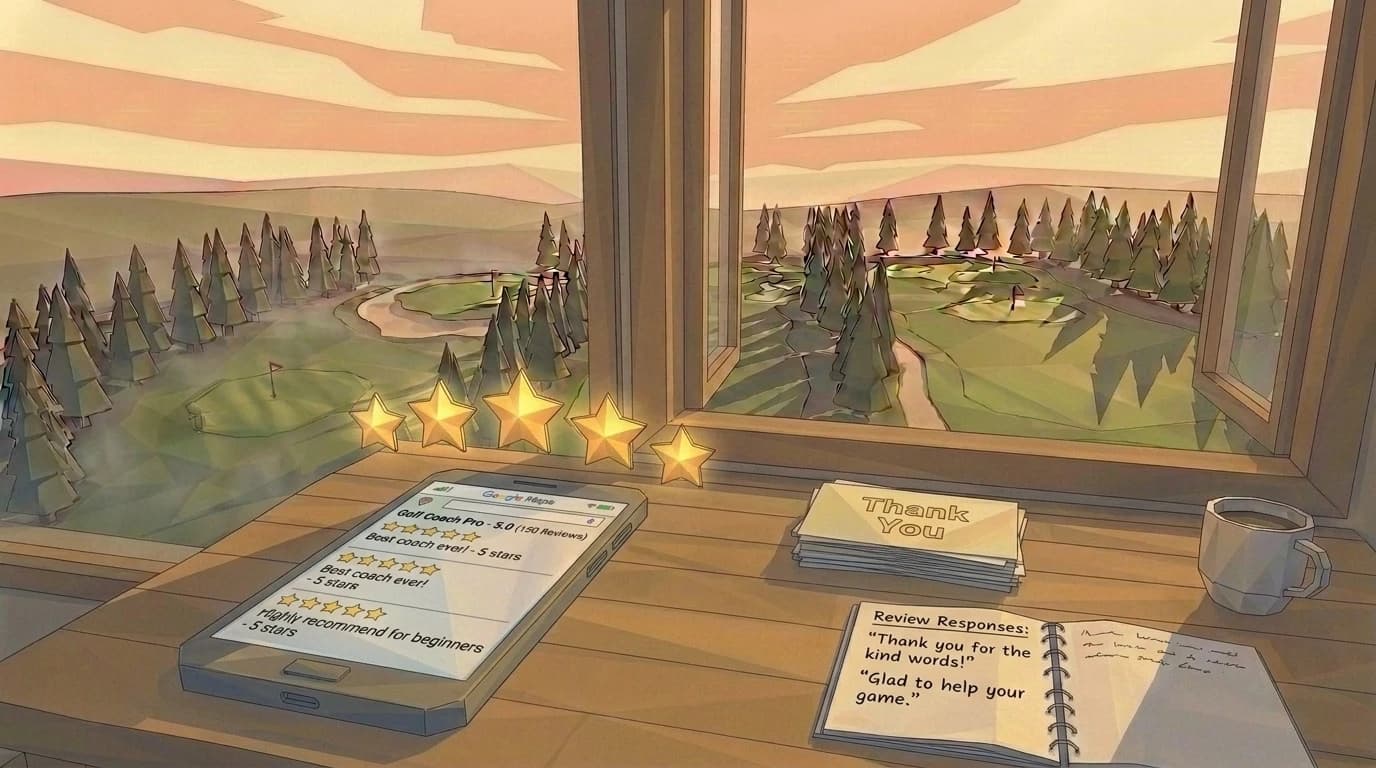
Mark got a 1-star review on a Wednesday at 11:08 PM. The student had reasonable issues — the lesson ran 8 minutes long, the cool-down got skipped, the price felt high for the value. By the time Mark saw the notification it was past midnight. He typed three drafts of a response inside the GBP app on his phone. He deleted all three. He posted a fourth at 12:23 AM, slept badly, and woke up to a follow-up email from the student saying thanks for the response and apologizing for the rating.
The thanks didn't change the star rating.
The response is what every future parent reading the page sees. The response is the part of the review the algorithm doesn't decide — the coach does.
The April 2026 review policy update — what changed
On April 17, 2026, Google rewrote its review-content and solicitation policies. The changes were aimed at home-services and small-business categories where review manipulation had gotten aggressive, but they apply to every Google Business Profile — including yours.
Three things explicitly became out-of-policy:
- Per-coach quotas at academies. A head pro telling each instructor to bring in 4 reviews a month, with name attached, is now a flagged pattern. Digital Shift Media's coverage of the policy update walks through how the per-tech quota ban targets multi-staff service businesses specifically — and academies fall under the same pattern recognition.
- Specific-content asks. Telling a student "could you mention me by name" or "could you mention the junior program" violates the new policy. The reason: those reviews stop reading like a spontaneous customer experience and start reading like marketing copy. Google's filter is trained on the difference.
- On-premises pressure. Handing a parent an iPad after the lesson and asking her to leave a review while the kid is still putting away his clubs. QR codes on the wall that drop directly into the review form. These are flagged now. The compliant version is asking afterward, in conversation, with an SMS containing the link sent later.
What's still allowed: the in-person ask after a good lesson, with the SMS follow-up containing your direct review link, sent within an hour or two while the experience is fresh. Email follow-up to a single past student (not a bulk send) is fine. The relationship-based ask hasn't changed. Only the pressure-tactic versions did.
The consequence of violating the policy is review filtering first (the reviews don't show up publicly even though they were written), and account suspension second for repeated patterns. Suspension is rare for a solo coach. Filtering is common, and most coaches don't realize it's happened to them.
The in-person ask — still the gold standard
The single highest-converting review request is the one that happens in person, right after a good lesson. The phrasing isn't complicated:
"If you've got two minutes, a Google review would really help me out. I'll text you the link."
That's the script. Don't dress it up. Don't put it in an email template that goes out to everyone. Say it once, in person, when the student is still on the range and the experience is fresh. Then send the SMS within the hour with your direct review link from the GBP dashboard.
The 4-step in-person ask flow:
- Identify the moment. End of a session that went well. Student is happy, kid is smiling, the parent watching from the bleachers is nodding. That's when. Not three weeks later in an email blast.
- Make the verbal ask. The script above. Two sentences. Direct. The specific phrase "would really help me out" is doing real work — it's honest, it's small, it doesn't pressure.
- Send the SMS within the hour. Use the direct review link from your GBP dashboard. SMS converts at substantially higher rates than email follow-up because the parent already had the conversation in mind. Don't bulk-send. Send one at a time, named, with a one-line note ("thanks for today — here's the link if you've got a minute").
- Don't follow up more than once. If they don't write the review, they don't write the review. A second follow-up signals desperation. The next ask is to a different student after a different good lesson.
Conversion rates we've seen across coach client analytics: 35-50% on the in-person ask plus same-day SMS, versus 6-12% on bulk email-only campaigns. The math isn't subtle. The in-person version is also the one that survives the April 2026 policy rewrite intact.
If you're doing the broader testimonials work — for your website, for case study material, for video — the testimonials playbook covers the longer-form ask, which is a different conversation than the Google review ask.
Responding to reviews — the 24-hour rule and the public-conversation pattern
Respond to every review. Positive ones, negative ones, the awkward middle ones. The response is the public conversation parents read before they decide whether to book.
The 24-hour rule applies to negatives. A bad review that sits unanswered for a week reads as either dismissive or absent. The first 24 hours after a negative is the window where your response shows you noticed, you cared, and you took it seriously. Even if the resolution is going to take longer, the acknowledgment within 24 hours is what the parent reading the page is checking for.
For positives, within a week is fine. The response can be shorter. The job is different — you're confirming the review was received and read, and you're adding the context that helps the next parent reading the page understand what kind of coach you are.
Use 4 response templates as starting points (rewrite each one in your own words):
- Positive — thanks with detail. "Thanks for the kind words, [name]. The work on [specific thing they mentioned — the chip yardage, the junior tournament prep, the swing path drill] is what I love teaching most. Hope to see you back at the range soon."
- Positive — thanks with callback. "Appreciate the review, [name]. Looking forward to the next session — we'll keep building on the [specific drill or focus] you've been working on."
- Negative — acknowledge. "Thanks for the honest feedback, [name]. You're right that [specific thing] could have been handled better. I'd like to make it right — would you email me at [your email] so we can talk through it?"
- Negative — take offline. "I hear you, [name]. This isn't the experience I want anyone leaving my lessons with. I'm going to follow up directly so we can talk through it — please look for an email from me today."
Use the reviewer's first name when it's visible. Mention what you teach naturally — "the junior swing fundamentals work" or "the chipping clinic on Saturdays" — because Google indexes the response text, and the natural mention is a small but real SEO signal.
Don't argue publicly. Don't reference student data publicly. Don't apologize three times — once is enough.
Negative reviews — the playbook that doesn't make it worse
Negative reviews happen. The realistic outcome is not zero negatives — it's a mostly-positive profile with a handful of legitimate criticisms handled well.
The pattern that doesn't make it worse:
- Calm, within 24 hours. No exclamation marks. No "I'm sorry you feel that way" — that's an apology that isn't one. Acknowledge what happened in plain language.
- Take it offline fast. Public review threads are not a place to litigate the lesson. Move to email or phone with the line "I'd like to talk through this — would you email me at [email]?" — and then actually follow up.
- Don't reference specific student data. Even if you remember the lesson clearly, the public response shouldn't include details only you and the student would know. That reads as defensive and Google's policy team flags it.
- Use the report option only when justified. Fake reviews, off-topic reviews, reviews that violate policy (hate speech, conflicts of interest, attempts at extortion) — those are reportable. Reviews you just disagree with are not.
The realistic ceiling on review removal: Google removes about 30% of legitimate fake-review reports. The other 70% you have to outrank with volume of legit ones. That's the math. It's frustrating, and it's also what the policy looks like in practice.
The one mistake everyone makes
Not responding to positive reviews.
A profile with 18 positive reviews and zero responses signals an inactive business. The parent reading the page sees: this coach got 18 nice things said about him and didn't acknowledge a single one. That's a vibe.
97% of consumers read review responses per BrightLocal's 2026 survey. The 30-second response to a positive review is the single highest-ROI minute in a coach's week. It's faster than answering an email. It's seen by every future parent who clicks on your profile. And the algorithm reads response activity as a freshness signal.
97% of consumers read review responses. The reply isn't for the reviewer — it's for the next parent reading the page.
The bar is low. Two sentences, a name, a specific callback to what they mentioned. Done in under a minute. Most coaches we audit have skipped the last 6 to 12 positive reviews entirely. Catching up is one Tuesday morning of work.
The full local-search picture — GBP, reviews, on-page, citations — is what the Google Business Profile pillar walks through end to end. The reviews piece is the input that compounds fastest. The prominence playbook covers where reviews fit in the broader Google Maps math. And the local SEO walkthrough covers how reviews stack with the other ranking factors.
If you want the website-side of the equation — what the site behind the GBP click needs to do to close the parent's decision — the pricing page lays it out.
Frequently asked questions
Frequently asked questions
In person, right after a good lesson: "if you've got two minutes, a Google review would help me out — I'll text you the link." Send the SMS within an hour with your direct review link from the GBP dashboard. Don't bulk-email past students — that triggers Google's filter. Don't ask each student to mention you by name — that violates the April 2026 policy. The relationship-based, context-specific ask is what survived the rewrite.
The in-person ask. The post-lesson SMS with your direct review link. Email follow-up to a single student (not a bulk send to your past-student list). What's banned: per-coach quotas at academies, specific-content requests like "mention my name," and on-premises pressure with tablets or QR codes during the lesson. The compliant version is the relationship-based ask after a good session.
Within 24 hours. Calm tone. Acknowledge the issue. Don't argue. Take it offline ("I'd like to talk through this — would you email me at [your email]?"). Don't reference specific student data publicly even if you remember the lesson clearly. The job of the response isn't to convince the reviewer to change the rating — it's to show every future parent reading the page how you handle criticism.
20 is the trust floor. 50+ is the "established coach" zone. Per BrightLocal's 2026 Local Consumer Review Survey, 47% of consumers won't use a business with fewer than 20 reviews. Below that, parents read your profile as a hobbyist. The volume isn't the only thing that matters — recency matters too, and 45% of consumers prioritize reviews from the last 3 months.
Sometimes. Google removes reviews that violate policy — fake reviews, off-topic reviews, hate speech, conflicts of interest, extortion attempts. Removal rate on legitimate fake-review reports is roughly 30%. The remaining 70% you have to outrank with volume of real reviews from real students. Don't burn weeks fighting one removal when three new positive reviews would solve the same problem.
Last updated .
Keep reading