It's Thursday morning at 8:47 AM. Diane is logging into the email platform that the previous marketing coordinator left when she quit in November. Username scribbled on a sticky note in the desk drawer. Password reset takes three tries. She gets in. The list shows 8,400 contacts. The last broadcast went out October 18th, 2025. Open rate on that one: 11%. The four broadcasts before that were also pro-shop sale-only emails. Same 11% open rate. Same un-clicked weekend specials buried in the footer.
She scrolls the list. Half the addresses are six years old. The other half haven't opened anything in 14 months. Somewhere in those 8,400 contacts are the ~2,200 active golfers who would actually open a Thursday-2pm weekend special. They're invisible inside the noise. The list hasn't been cleaned since 2022.
This post is the version that fixes that. Six emails, in order, with subject lines and send timing. The benchmarks worth measuring against. The list hygiene work that has to happen first. Most golf courses are running zero or one of these six emails. The ones running all six are filling weekday twilight at numbers the rest of the industry can't explain.
Email is the highest-ROI channel most golf courses underuse
The numbers aren't subtle. Travel & Hospitality benchmarks per Salesforce 2026 industry data put best-case open rates at 72% on automated flows. Realistic golf course benchmarks land at 31-39% open and 3-8% click-through. Klaviyo's 2026 industry data shows automated flows produce 41% of email revenue from 5.3% of total sends — meaning the automation is doing 8x more work per send than broadcast campaigns.
The list-hygiene caveat shows up immediately. Even a perfect 6-email sequence sent to a stale list returns garbage — the open rate looks awful, the spam score climbs, and the email platform's deliverability across the entire account starts degrading. Clean the list before you send better emails. The fix is mechanical, not creative.
The 6-email sequence — the structure
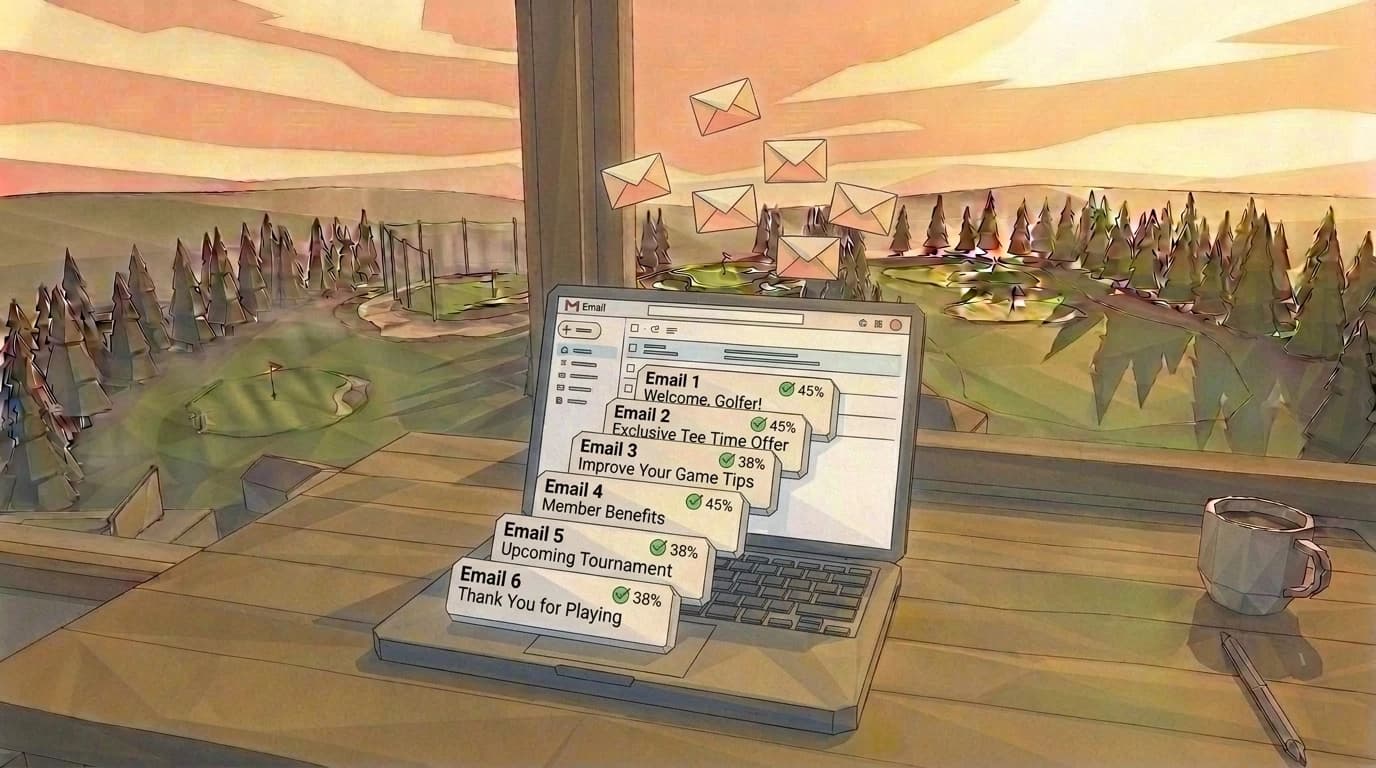
Six emails. Each one triggered by a different event. Each one with a single job.
- Welcome (day 0, immediate after signup) — set expectations, deliver practical info, drop the first booking incentive.
- Tee time reminder (24 hours before booked round) — reduce no-shows, upsell pro shop and F&B, set pace expectations.
- Weekend special (Thursday afternoon broadcast) — capture the impulsive Friday-Saturday booking decision.
- League or clinic signup (seasonal — Feb-Mar for spring, Aug-Sep for fall) — drive recurring revenue programs.
- Lesson upsell (after the 3rd round played) — bridge to the course's coaching staff. The natural cross-sell.
- Win-back (triggered at 90 days no booking) — reactivate lapsed customers before they're gone for good.
The first five emails are the engine. The sixth is the safety net. Most courses ship zero of the six. Setting up emails 1, 2, and 3 alone covers ~85% of the revenue lift you'll see from this whole list. The remaining three are the difference between average and excellent.
Email 1 — Welcome (with subject lines that actually open)
Welcome emails get 3-4x the open rate of regular sends because the recipient just opted in — they're at peak engagement. Don't waste it on a logo and a "thank you for joining" sentence.
Three subject line options that work for golf courses:
- "Welcome to [Course]. Here's the thing nobody tells new bookers."
- "Your tee time is locked in. Read this once."
- "[Course] in 3 minutes: parking, pace, what to bring."
Body skeleton (~150 words). First paragraph: practical info — the parking entrance, the pace expectation (4 hour 15 min target), the dress code if there is one, when to arrive (15-20 min early), what's in the pro shop. Second paragraph: a specific soft offer — "Twilight rate after 3 PM is $39 — book at [link] with code WELCOME for 10% off your first round." Third paragraph: a single GBP review request, deferred — "Once you've played, if you've got 30 seconds, leave us a Google review at [direct link]. It's the single most useful thing any new golfer can do for us."
Email 2 — Tee time reminder (the operational gold)
Subject: "Your [Course] tee time tomorrow at [time]"
Body: weather forecast, pace expectation, F&B pre-order link if available, pro-shop bag-tag link, parking entrance reminder. Send 24 hours before booked round.
This single email reduces no-show rate measurably across most courses — typical reduction is 30-40% on the no-show line. The math is straightforward: a no-show on a $48 weekend slot is $48 of revenue you can't recover. Reducing 8 no-shows a week saves ~$385 a week, or $20K a year. The email costs $0 to send if you're already on a platform.
The upsell layer matters. F&B pre-order capture from the reminder email runs $4-$12 per opened email at courses that have set it up. The pro-shop bag-tag link is the lowest-effort upsell add — most courses have new bag tags they're trying to move and most golfers are open to a $15 add-on at the moment of pre-arrival.
Email 3 — Weekend special (the revenue email)
Subject: "[City] weekend forecast: clear, $45 twilight, here's the link"
Send: Thursday at 2 PM. The window matters. Friday-Saturday booking decisions get made starting Thursday afternoon when the weekend is finally on the mental horizon. Earlier than Thursday and the email gets buried by the time the decision is being made. Later than Thursday and the recipient is already at dinner with their partner negotiating the weekend's plans.
Body: weather (Friday-Sunday), the dynamic-pricing twilight slot in plain language, one-click booking link. Don't include three offers. Include one. A/B test the offer — twilight rate vs. cart-included vs. group-of-4 discount — across consecutive Thursdays and let the data pick.
The Thursday-afternoon weekend email is the single highest-ROI send most courses can run. It targets the impulsive Friday-Saturday booking decision when it's still mentally available. Most courses send their weekend email on Wednesday morning. Wednesday morning is too early — the decision hasn't surfaced yet.
Email 4 — League or clinic signup (seasonal recurring)
Spring leagues need three send waves: February 15 (early-bird capacity), March 1 (mid-season urgency), March 15 (last-call). Same template, escalating urgency.
Subject for the second send: "Spring league fills in 2 weeks — 4 spots left in Wednesday twilight"
Body: format details (8 weeks, 9-hole stableford, $60 entry, prize structure), scarcity reminder ("12 of 16 spots taken"), signup deadline, link. Add a sentence on the social/community angle — leagues sell on the social experience, not the golf.
Fall leagues launch at the inverse cadence: August 15, September 1, September 15. Same email shape, different weekday targeting (post-Labor-Day audiences are more responsive to weekend leagues than weekday).
Email 5 — Lesson upsell (the coach bridge)
Trigger: after the recipient has played 3 rounds at your course. Pull from the booking system.
Subject: "You've played [Course] 3 times. The next one looks better."
Body: name the head pro, name the lesson program, note that lesson availability is shaped around member tee times, link to the head pro's booking page. If your facility has multiple instructors with their own pages, route to the one whose specialty matches the recipient's likely need (junior parent vs. adult beginner vs. league player).
This is the email where the coach-product slots in. If your facility has coaches running their own websites for outside lessons, the lesson upsell email is the natural conversion — the recipient already plays at your course, they trust the brand, and they're being introduced to a coach who teaches there. The conversion rate on this email runs 3-7% to a booked lesson, which is dramatically higher than any cold-acquisition lesson lead.
Email 6 — Win-back (the lapsed-customer email)
Trigger: 90 days no booking. Send once. Don't follow up — a second email at 120 days reads as desperate.
Subject: "We pulled your tee time history. Here's what we noticed."
Body: name the specific gap ("Your last round was March 14. The weather since then has actually been ideal."). One offer ("Twilight rate plus a free range bucket for any round booked this month"). One link.
The win-back email's job isn't to convert most lapsed customers. It's to identify which lapsed customers are convertible. The rate of opens vs the rate of unsubscribes will tell you whether your retention problem is structural (course condition, pricing, competing courses) or operational (you stopped emailing them and they stopped thinking about you).
List hygiene + CAN-SPAM (the boring but mandatory part)
Clean every 90 days. The mechanic: identify any contact who hasn't opened an email in 6+ months. Move them to a separate list. Send a single re-engagement email asking if they want to stay subscribed. Anyone who doesn't open or click within 14 days gets unsubscribed automatically. The platform will do this if you set up the segment.
CAN-SPAM compliance is non-negotiable. Every email must have:
- Working unsubscribe link in the footer
- Physical mailing address (your course's actual address)
- Accurate "From" line — your course name, not a generic "team@"
- No deceptive subject lines
For the broader playbook this email post slots into, see the full golf course marketing playbook and the marketing plan template with the math. For the loyalty-app angle that pairs with email 6 (win-back), see the loyalty app prepaid round packages idea (idea #12 in the marketing ideas list).
A note before the FAQ
We don't manage email programs for golf courses. We don't even build the email templates. What we do — and the reason this post exists — is build websites where the email signup form is the first thing the visitor's allowed to do, not the third. Most golf course sites we audit have the email signup buried in the footer, on a default form that hasn't been styled to match the site, and that captures 0.4% of visitors.
The 6 emails above don't matter if the list isn't growing. The list doesn't grow if the signup form isn't visible. The signup form isn't visible because the website hasn't been touched in 18 months. That last part is the part we'd build for. For coaches. Not for full courses. The honest distinction we keep flagging on every Cluster G post.
For the coach version of this same setup — where the email signup form is built in from day one and integrates with the booking platform — see the lesson upsell email lands on the coach's website. For the productized pricing math, see our pricing.
Frequently asked questions
Frequently asked questions
Realistic benchmark: 31-39% open rate for golf and hospitality. Best-case automated flows hit 72% per Salesforce industry data. If you're below 25%, the issue is usually list hygiene, not subject lines. Below 15%, the list is dead and needs a re-engagement campaign before any creative work matters. Click rates run 3-8% on the realistic golf benchmark.
One automated welcome flow (sends once per new contact). One automated tee-time reminder (sends 24 hours before each booked round). One weekly broadcast (Thursday weekend special). Three seasonal sends per league cycle. One lesson upsell triggered per qualified contact. One win-back triggered at 90 days lapse. That's it. More frequency than this and the open rate collapses; less than this and the revenue isn't being captured.
Thursday at 2 PM for the weekend special (the highest-ROI broadcast). Tuesday morning for league and event recruitment. Friday morning for the operational tee-time reminders. Avoid Mondays (open rates drop) and weekends (the audience is at the course or doing something else). The Thursday-2pm window outperforms every other broadcast slot we've tested across mid-tier public courses.
No. Purchased golf-customer lists are mostly junk — recycled, scraped, or stale. Sending to a purchased list will tank your sender reputation, which collapses your real list's deliverability across the entire account. The recovery time is 30-60 days during which your good emails go to spam. Build organic. The signup form on your website, the GBP listing, the in-clubhouse iPad capture — all three are slower but they actually work.
For most public courses: Mailchimp ($30-$200/mo) or Constant Contact ($30-$120/mo) — usable, good deliverability, fine UI. For mid-large courses with revenue automation needs: Klaviyo ($100-$400/mo) — more powerful, better automation, better reporting. For golf-specific automation tied to the tee sheet: Course-Logix or Club Caddie's email module — golf-specific triggers but pricier and less flexible. Pick based on the team's technical capacity, not the feature list.
Set up the automated 24-hour reminder email triggered off the booking system. Include weather, pace expectation, parking entrance, and an F&B pre-order link. The reduction in no-show rate is consistent across courses — typical 30-40% reduction on the no-show line. At an $48 weekend slot, recovering 8 weekend no-shows per week is ~$385/week, ~$20K annually. The reminder email is the single highest-ROI piece of email infrastructure most courses don't have set up.
Last updated .
Keep reading