It's 6:42 on a Wednesday morning at a mid-tier public course in central Ohio. Diane, the GM, is standing at the cart barn with a clipboard. The crew is finishing the tarps on the greens. She's looking at last week's rounds report. Weekday utilization sat at 47%. The marketing line item on the same page reads $3,200. Three thousand two hundred dollars. Four hundred and seventy rounds short of where the budget assumed she'd land.
She's run two ad agencies in the last 18 months. She's posted on Facebook every weekday at 9 AM for two years. The email list has 8,400 contacts. The last broadcast went out in October. The pro shop sale-only emails are the ones that still get opened. She doesn't know which line item is broken. She suspects all of them are.
This guide is the long version of what she'd actually need to read before her board meeting on Friday. The short version: ~15,000 US golf courses are competing for ~470 million annual rounds, marketing isn't optional anymore, and the gap between 65% and 75% utilization is the whole margin.
What golf course marketing actually is in 2026 — and what it isn't
Golf course marketing is the set of channels, content, and measurement work that moves a specific golfer from "I might play this weekend" to a paid tee time at your course rather than the one three exits up the highway. That's it. It is not branding. It is not "engagement." It is the layer that connects intent to inventory, measured in rounds and revenue.
The shift since 2018 is that 50-65% of a course's marketing spend now goes digital, per the NGCOA Modern Guide to Marketing. Print is still in the mix at private clubs and at the older end of the public-course audience, but digital-first is now the operating assumption. The five channels that matter — local search, email, Meta, partnerships, events — are all measurable. If you can't attribute rounds to a channel, that channel is decoration.
The reason this matters: most "golf course marketing" advice on the internet is written by software vendors trying to sell you software. Lightspeed wants you to buy POS. GolfNow wants you on its tee-time inventory. Club Caddie wants the email module. None of them are wrong about their own product. All of them are silent on the parts that don't fit their product. This guide is the part that names everything.
The numbers every course operator should know before spending a dollar
The National Golf Foundation puts US course count at ~15,000-16,000 facilities. Annual rounds played sit between 450 and 475 million. The average tee time utilization at a public course is 65-75%. Premium and resort courses hit 80%+. Below 60%, the course is structurally underutilized and marketing alone won't fix it — operations and condition usually have bigger leaks.
Marketing budget benchmarks across Sagacity Golf and NGCOA data: 3-6% of revenue for public courses, 2-4% for private. A $1.5M-revenue public course should be running a $45K-$90K annual marketing program. Most we audit are running $25K-$40K. Half of that is going to one channel that nobody's measuring.
| Utilization | Course type | Recommended spend (% of revenue) | Rounds you're trying to move per year |
|---|---|---|---|
| 55-65% | Underutilized public | 5-6% | 8,000-15,000 incremental |
| 65-75% | Healthy public (most courses) | 3-5% | 3,000-8,000 incremental |
| 75-85% | Premium public / semi-private | 2-4% | 1,000-3,000 incremental |
| 85%+ | Resort / private flagship | 2-3% (mostly retention) | Retention focus, minimal acquisition |
The number to write on a sticky note: $3-8 cost per booking online. If you're paying $20 per booking, the channel is broken. If you're paying $1.50, you've found something — scale it. Anything between those two extremes is normal and worth optimizing.
The four frameworks that actually structure a marketing plan
Most "golf course marketing strategy" advice falls back on one of four named frameworks. The frameworks aren't magic — they're shorthand. But they're the shorthand the People Also Ask box keeps surfacing, so it's worth knowing them cold.
The 70/30 rule
Seventy percent of the budget on retention. Thirty percent on acquisition. Most plans we audit are inverted — they put 70% on acquisition and starve the existing-customer channels. The math doesn't work because the existing customer is 5-7x cheaper to keep than the new customer is to win.
The 70/30 rule applied to a golf course: 70% of marketing goes to email automation, member communications, GBP responses, league recruitment, and review generation. 30% goes to paid Google, Meta lookalike, and net-new-golfer events. Inverting that — which is what happens when a paid-ads agency designs your plan — is the single most expensive mistake on the page.
The 70/20/10 rule
Seventy percent of spend on proven channels (paid Google Search, GBP-driven organic, email). Twenty percent on emerging channels you've validated for your market (Reels, retargeting, influencer partnerships). Ten percent on experimental channels you're piloting (TikTok, podcast sponsorship, geofenced display).
The point of the rule is forcing the conversation about each bucket. Most plans we audit have 100% in proven and 0% experimental — which means they're not learning anything new, which means in 18 months the proven channels will start losing efficacy and there's no replacement queued.
The 3-3-3 rule
The first three days of a new golfer's relationship with your course. The first three months. Months three through twelve. Each window has a different marketing job:
- First 3 days: practical info delivery, thank-you, GBP review ask, second-round soft offer.
- First 3 months: behavioral re-engagement, weekend twilight email, league pitch when seasonally relevant.
- Months 3-12: lifetime-value optimization, member upgrade path, referral program.
Most courses run the same generic newsletter to everyone, regardless of where they sit in the 3-3-3 windows. That's why the open rate is 11% instead of 35%.
The 7 pillars (the 7 P's of marketing)
Product, price, place, promotion, people, process, physical environment. Originally the CIM-defined marketing mix, which expanded the classic 4 P's framework. For a golf course in 2026:
- Product: course condition, tee sheet flexibility, F&B, the lesson program.
- Price: green fees, dynamic pricing, packages, membership tiers.
- Place: physical course + the digital "place" (website, GBP, third-party listings).
- Promotion: the marketing this whole guide is about.
- People: the staff golfers actually meet — pro shop, starter, ranger, head pro.
- Process: tee time booking flow, check-in, pace of play, post-round survey.
- Physical environment: clubhouse, parking, signage, range, restrooms.
Marketing without the other six pillars is just shouting. The 7 P's are the reminder that the website fixing the website doesn't fix the course.
Most golf course marketing plans we audit fail one obvious test — they treat acquisition like the only job. The 70/30 rule is the single biggest correction available to a public course. Flip the budget. Watch retention numbers move in 60 days.
The five channels that actually move rounds
The set of channels worth caring about is short. Here it is, ranked by what we see actually moving the booking number for mid-tier public courses.
Local search (Google + Google Business Profile)
The anchor channel. CPC for "golf courses near me"-style terms runs $2-6 in most US metros. Conversion rate on a properly-tracked tee time funnel is 3-8%. A complete GBP — primary category set to "Golf course," 25+ photos, review cadence under 90 days, weekly Posts — drives a measurable lift in map-pack visibility within 30-60 days.
Most of this is free. The GBP itself costs nothing. The Google Search ads on top of it are paid. Together, they're the single highest-ROI channel for ~85% of US public courses.
Open rates of 31-39% and CTR of 3-8% are the realistic golf-and-hospitality benchmarks per Klaviyo's 2026 industry data. Travel & Hospitality benchmarks from Salesforce push the open-rate ceiling to 72% in best-case automated flows. Automated flows produce 41% of email revenue from 5.3% of total sends. That asymmetry is the entire argument for setting up a real welcome sequence and a Thursday-2pm weekend email — see the 6-email sequence that actually books tee times for the full skeleton.
Meta (Facebook + Instagram)
Reels CTR runs 2.08-2.14%. Lookalike audiences from past bookers, combined with a 15-30 mile geo radius and Advantage+ targeting, deliver a typical 32% reduction in CPA versus broad targeting. Meta's job at a golf course is demand creation — interrupting the feed of someone who hasn't thought about golf this week and putting your course in front of them. Don't expect direct response on the same day. Expect retargeted re-engagement across two to four weeks.
Influencer and community partnerships
Micro-influencers (5K-50K followers) outperform big names for local conversion at courses, mostly because the audiences are local and the cost is dramatically lower. A $500-$2,000 partnership with a regional golf creator usually beats a $10,000 partnership with a national one for booking lift. Community partnerships — high school programs, junior camps, charity events — layer on top with measurable spillover to weekday rounds.
Tournament + event hosting
A charity scramble brings 80-144 golfers to your course in one day. Half of them have never played there. The website spec for those events is its own discipline — see the tournament website guide — but the bookings tail of a hosted charity event runs 60-120 days post-event and is the single most underrated revenue lift in the channel mix.
| Channel | Typical CPL / cost-per-booking | Time to first signal | Min monthly spend |
|---|---|---|---|
| Google Search Ads | $3-8 per booking | 7-14 days | $1,200-$2,500 |
| Google Business Profile (organic) | $0 direct | 30-60 days | Time only ($0 cash) |
| Email (automated flows) | <$0.50 per booking | Immediate (existing list) | $30-$120 platform fee |
| Meta Lead Gen / Reels | $5-12 per lead | 10-21 days | $800-$2,500 |
| Influencer (micro) | $15-30 per booking | 21-45 days | $500-$2,000 per partnership |
| Print / radio | Unmeasurable in most setups | Unknown | Don't bother |
For the deeper paid + organic split with current 2026 benchmarks, see the paid + organic spend breakdown.
The website is the conversion floor — and most courses leak here
Every dollar of marketing eventually sends someone to a URL. That URL has 1.5 to 3 seconds to convince them to book before their attention fragments. The booking embed loads. The page repaints. The CTA is or isn't visible above the fold. The mobile menu either works or doesn't. The footer either has the phone number or doesn't.
A 4-second site loses ~25% of mobile visitors before the page paints. That's per Google's own Core Web Vitals research. Twenty-five percent of paid clicks vanishing because the page is slow is the silent leak nobody on the marketing team wants to bring up because it's the IT team's problem. It is not the IT team's problem. It is the marketing team's problem, because the marketing team is paying for the clicks.
Tee time booking integration is the second leak. Lightspeed Golf, foreUP, Club Caddie, and GolfNow all expose embed-able booking widgets. The widget either matches the visual treatment of the rest of the site or it doesn't. Most don't. The visual mismatch alone tanks conversion 10-15%, because the visitor reads "different vendor, different system, am I about to be redirected somewhere weird, never mind." Investing in the embed visual integration is unsexy and load-bearing.
This is the part where we have to admit something. We don't actually build websites for full courses. Our product is for coaches. But every coach we work with shares this exact problem with the courses they teach at — slow sites lose the click, the fix on the coach side and the course side is the same. Speed, GBP, the email list nobody's using. We can fix it for the coaches at your facility. We can't fix it for the course site itself.
The marketing technology stack — what every course actually needs
The MarTech landscape is overwhelming. Here's the short version of what every public course actually needs in 2026:
| Tool | Category | Typical price | Best fit |
|---|---|---|---|
| Lightspeed Golf | POS + tee sheet + CRM bundle | $200-$600/mo + transaction % | Mid-large public, semi-private |
| foreUP | Tee sheet + booking + email | $300-$800/mo | Mid public courses |
| Club Caddie | POS + tee sheet + email + member mgmt | $400-$900/mo | Private + upscale public |
| Sagacity Golf | Revenue management + dynamic pricing | $500-$2K/mo | Mid-large public chasing yield |
| GolfNow | Tee time inventory marketplace + ads | Variable (revenue share) | Any course wanting incremental fill |
| Constant Contact / Mailchimp | Email-only | $30-$200/mo | Small + mid public |
| Course-Logix | Golf-specific email automation | $150-$400/mo | Mid-large public, multi-course |
| Google Analytics 4 | Analytics / measurement | Free | Every course, no exceptions |
| Google Business Profile | Local search anchor | Free | Every course, no exceptions |
The two non-negotiables: GA4 with proper conversion tracking on the actual booking confirmation event (not page views), and a complete GBP with a posting cadence. Everything else is sequencing.
Hiring an agency vs in-housing it — the honest math
Boutique digital agency retainer: $1,500-$4,000/mo. Full-service golf agency: $4,000-$12,000/mo. In-house marketing manager loaded cost: $55-$80K/yr, or roughly $5,000-$7,000/mo when you account for benefits, software, and the ramp time.
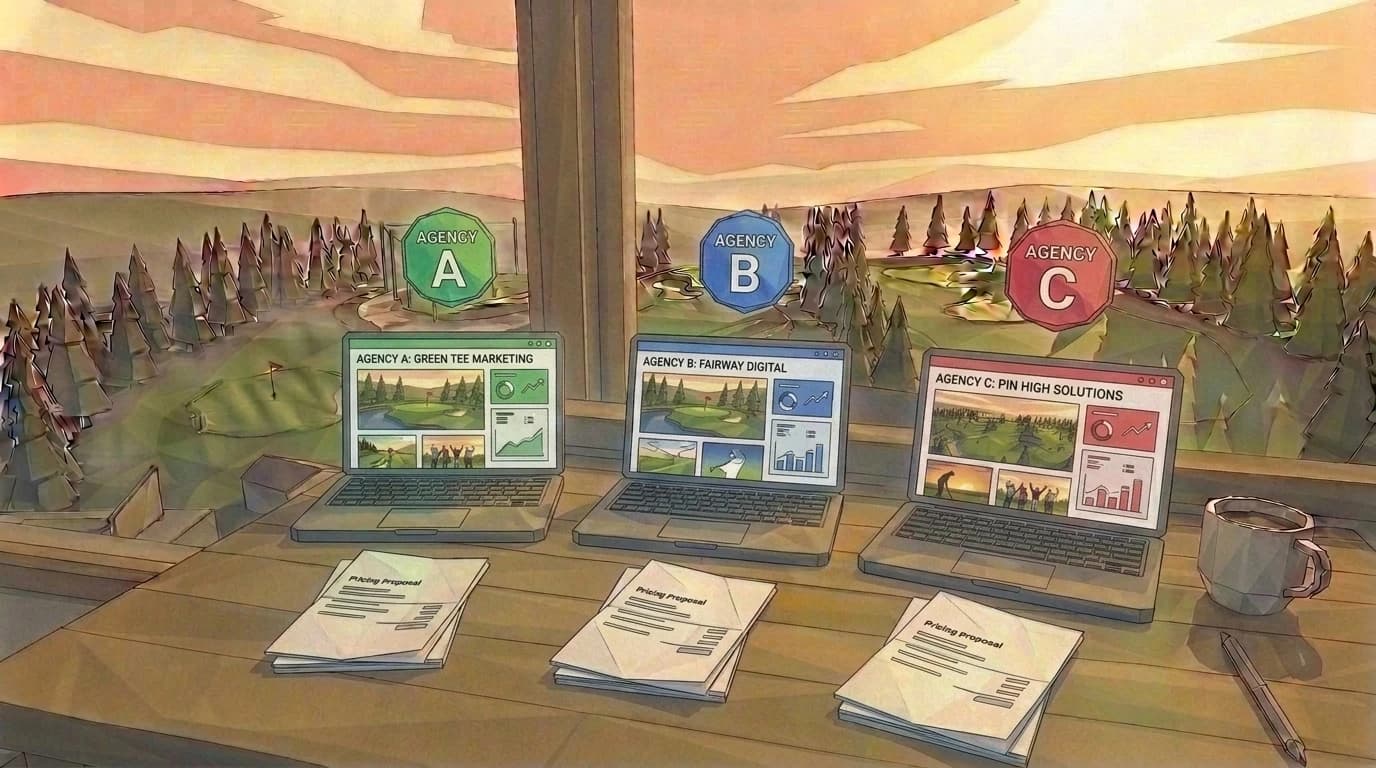
The tipping point: if you're spending more than $5K/mo on marketing and you don't have a dedicated person owning it, you're either underspending on the spend or overspending on agency markup. Either way, it's worth modeling. For the named-agency comparison with pricing fine print, see the agency comparison post.
The agencies aren't the problem. The brief is the problem. Most courses can't write a brief specific enough for an agency to execute against, so the agency delivers the generic plan and bills for it. The fix is rewriting the brief, not switching agencies.
The 90-day plan a course can actually execute
Below is the worked example. Budget: $3,000/mo (a realistic mid-tier public course at $1.2M annual revenue × 3% marketing). Persona: Diane's course from the cold open. Goal: move utilization from 47% on weekdays to 60% over 90 days, then assess.
| Week | Activity | Owner | Channel | Spend | Expected outcome |
|---|---|---|---|---|---|
| 1 | GA4 audit, fix conversion tracking on booking confirmation | GM + IT | Measurement | $0 | Tracking baseline established |
| 2 | GBP completion: 25 photos, hours, services, weekly Post #1 | Marketing coord | Local search | $0 | Map pack signal in 30 days |
| 3 | Email list cleanup (drop 6+ mo unengaged), import to ESP | Marketing coord | $120 platform | List goes from 8,400 to ~3,400 engaged | |
| 4 | Welcome flow + Thursday weekend email built and scheduled | Marketing coord | $0 (platform-included) | First sends ~ Week 5 | |
| 5 | Google Search Ads launch — branded + 2 local commercial keywords | GM + agency or self | Paid Google | $1,200/mo cap | 5-15 bookings in week 8 |
| 6 | Meta retargeting set up against website visitors (Pixel ready) | Marketing coord | Paid Meta | $400/mo | Retargeting impressions begin |
| 7 | First Reel published: weekday twilight rate announcement | Head pro + phone | Organic Meta | $0 | Engagement baseline |
| 8 | Thursday weekend email send #1 + measurement check | Marketing coord | $0 | Open rate ≥ 28%, CTR ≥ 4% | |
| 9 | GA4 review: cost per booking by channel, kill anything > $20 | GM | Measurement | $0 | Channel kill list |
| 10 | Reallocate budget to top channel + Reel #2 | GM + Marketing coord | Mixed | $3,000 reallocated | +$1,500 to winner |
| 11 | Charity scramble outreach to 3 local nonprofits for fall hosting | GM | Partnerships | $0 cash, time only | 1 confirmed event in 60-90 days |
| 12 | 90-day report: utilization, ROAS, cost per booking, what to keep | GM + board | Measurement | $0 | Plan v2 written |
If the budget gets halved mid-quarter, the kill order is fixed: experimental Reels production goes first, paid Meta retargeting second, paid Google ads third. Email and GBP never get cut. They're the floor.
For the editable version of this plan with audience segments and budget tiers at $3K, $8K, and $25K/mo, see the 90-day template with the math. For the cross-budget version that also handles solo-coach scale, see the 90-day plan for any-budget course or coach.
The cluster admission close — why this guide ends here
Here's the part we have to be honest about. We don't actually build websites for full golf courses. golfcoachwebsites.com is for individual coaches — solo PGA and LPGA pros, junior coaches, club head pros teaching outside lessons, and small academies. We wrote this 3,500-word guide on golf course marketing anyway because the team behind this site has built marketing for Golf Channel Academy, Troon properties, and PGA Tour coach personal sites — and the fundamentals on a course site and a coach site are 80% the same.
Site speed. GBP. The email list nobody's using.
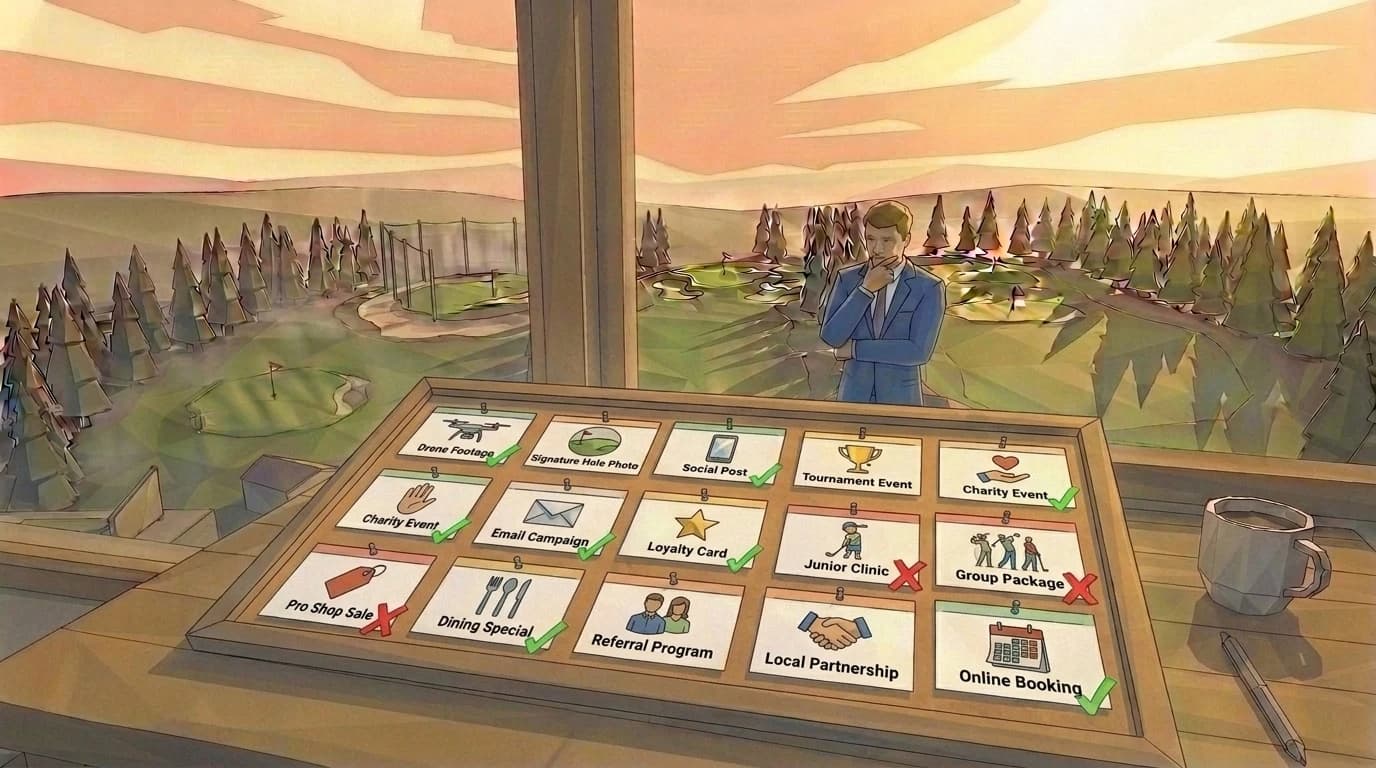
If you're Diane and you came here for course-marketing advice, we hope this helped. The clipboard-on-a-Wednesday-morning version of the answer is: rebalance to 70/30 retention/acquisition, fix GA4 first, set up the Thursday-2pm weekend email, complete the GBP, and run the $3,000 plan above for 90 days before changing anything else. Then read the agency comparison before you sign with anyone, and keep the 14 marketing ideas with the actual revenue math on your desk for when the next quarter's planning starts.
If you read this and realized half of what's broken at your course is also broken on the websites of the coaches who teach there — that's the part we can fix. Send them this guide first. Then send them us at the productized $99/month coach-website service. Or send them straight to what we do build, and at what price.
Diane finishes the report by Friday. Her board approves the rebalance. The Thursday email goes out the next week. Open rate is 34%. The pro shop sale-only emails get retired. The list builds back from 3,400 toward 6,000 by Labor Day, which is when the math actually starts closing.
Frequently asked questions
Frequently asked questions
Golf course marketing is the set of channels, content, and measurement work that moves a specific golfer from intent to a booked tee time at your course rather than a competing one. It includes local search and Google Business Profile, email, paid Google and Meta, organic social, partnerships and event hosting, and the website performance underneath all of that. It is not branding alone. It is the layer connecting golfer intent to course inventory, measured in rounds and revenue.
The 3-3-3 rule splits a customer's relationship into three windows — the first three days, the first three months, and months three through twelve — and assigns a different marketing job to each. For a golf course, the first three days handle practical info, a thank-you, and a GBP review ask. The first three months focus on behavioral re-engagement and league or twilight pitches. Months three through twelve are about lifetime value — referrals, member upgrades, and lapse prevention.
The 70/30 rule has two meanings depending on context. In marketing — the version most operators ask about — it's the budget split: 70% on retention (existing customers), 30% on acquisition (new). Most golf course plans we audit have it inverted, which is the single most expensive mistake on the page. Separately, in the swing context, the 70/30 rule is sometimes used for weight distribution at address. The marketing version is what shows up in tee-time numbers.
Seventy percent of marketing spend on proven channels (paid Google, GBP-driven organic, email). Twenty percent on emerging channels you've validated for your market (Reels, retargeting, micro-influencers). Ten percent on experimental (TikTok, geofenced display, podcast sponsorship). The point is forcing a conversation about each bucket — most plans have 100% in proven and 0% experimental, which means the channel mix is brittle when proven channels lose efficacy.
Product, price, place, promotion, people, process, physical environment — the expanded marketing mix from the original 4 P's framework. For a golf course: product is course condition and the lesson program; price covers green fees, dynamic pricing, and memberships; place is the physical course plus the digital surface; promotion is the marketing this guide covers; people are pro shop and starter staff; process is the booking flow; physical environment is clubhouse and signage. Marketing without the other six pillars is shouting.
Anchor on Google Search Ads plus a complete Google Business Profile, then layer Meta retargeting against website visitors, then add Reels for demand creation. Realistic monthly minimum to learn anything: $1,200-$2,500 on Google, $800 on Meta. Email comes free with your existing list — set up a welcome flow plus a Thursday-2pm weekend email and the automated revenue starts compounding inside 30 days. Don't pay for print or radio unless you can attribute rounds to it. You won't be able to.
Public courses: 3-6% of revenue. Private clubs: 2-4%. A $1.5M-revenue public course should run $45-90K annually. A $5M club is at $100-200K. Within that, 50-65% goes digital. The single most common pattern we see is courses underspending on what works (email, GBP) and overspending on what's measurable but unmeasured (paid ads with no booking attribution). Fix the attribution before you change the budget.
Yes. GolfNow inventory is a tee-time fill channel — it competes with you on price the moment a golfer searches your name. Your own site is where you control the brand, the booking flow, the email capture, and the visual continuity between marketing and the booking confirmation. Courses that run on GolfNow only end up paying revenue share on bookings they could have captured directly. Use GolfNow as overflow, not as the front door.
Last updated .
Keep reading