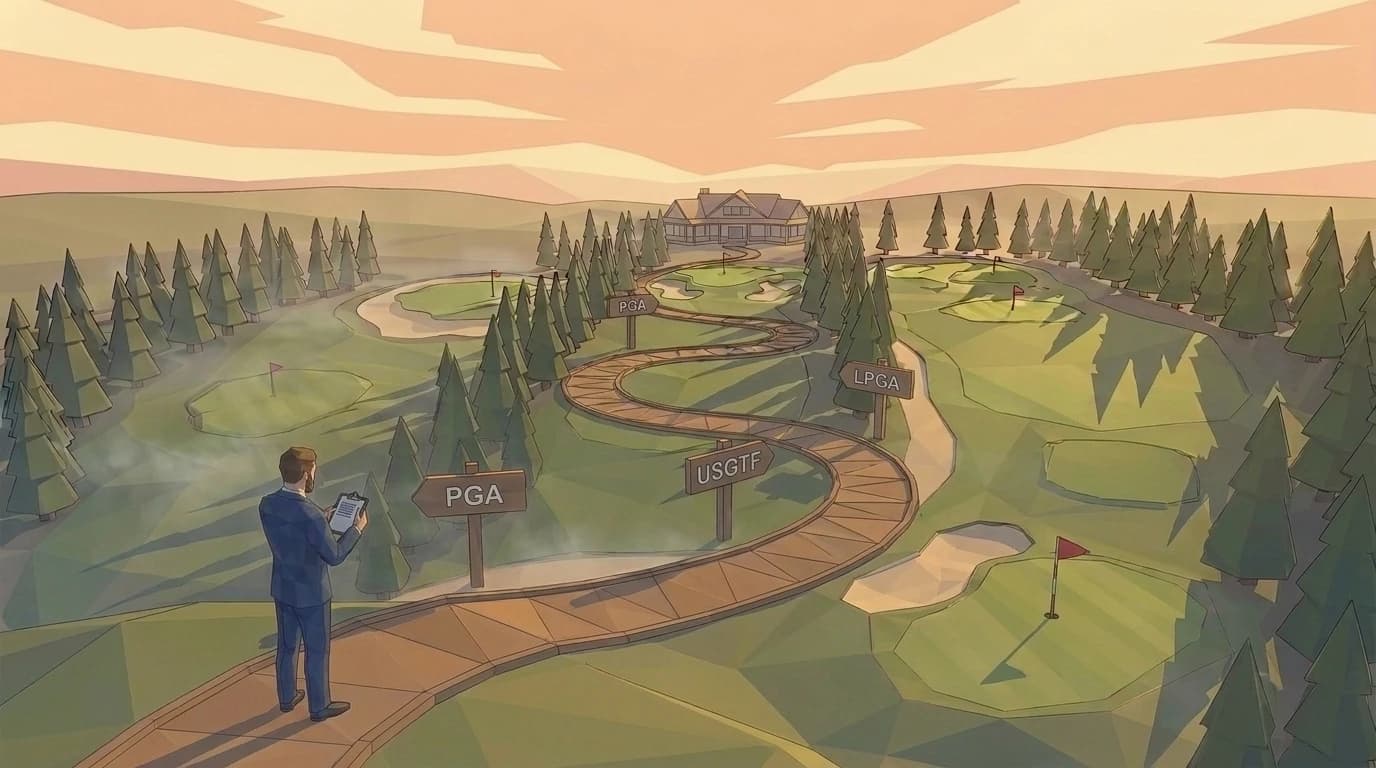
It's 7:42 on a Sunday morning in Cincinnati. Alex is on his second cup of coffee — third, technically, since the first one went cold while he was loading the dishwasher. The clean mug situation is desperate. He's drinking out of a chipped one with his college team's logo on it because everything else is in the dishwasher from yesterday. His two-year-old just walked into the kitchen, asked for milk, and got a "give me a sec, buddy" while Alex closed the laptop on his thumb.
Three tabs open. PGA.org's "How to become a PGA professional." USGTF's certification page. A Google search for "golf instructor salary" that has him 11 results deep into Reddit.
He's been doing this Sunday for eight months.
The brochure for USGTF has been in his desk drawer since last August. He keeps the PGA.org page bookmarked but he's never made it past the part where they mention the Player Ability Test. Alex is a 10 handicap from college — captain his senior year at a small Division III school — but he hasn't played a competitive round in eleven years. He works in pharmaceutical sales. He's been teaching his nephew to chip in the backyard for two years. He'd quit the sales job tomorrow if he had a real plan.
This guide is the plan he can't find anywhere else. Not because it doesn't exist — because every article ranking on Google is published by an organization that sells one of the certifications, and they all bury the comparison the reader actually needs.
The four real paths to becoming a golf instructor in 2026
Every article on page one of Google for "how to become a golf instructor" is published by an organization that wants you to pick their path. PGA.com pushes the PGA. Keiser pushes the four-year college route. PGTAA pushes itself. USGTF pushes itself. None of them publish the comparison because the comparison would lose them the lead.
Here are the four real paths. We sell websites — not certifications — so the bias here is structurally lower than the rest of the SERP.
- PGA of America PGM — the country-club / tour-coaching credential. 4-4.5 years from start to Full Member. Per the PGA of America's published 2026 cost overview, core fees run about $8,414. All-in, with travel and lodging across three seminars at the PGA Education Center in Frisco, Texas, plus dues and a typical handful of PAT retakes, you're looking at $25,000-40,000+. A four-year degree (or equivalent work experience) is required.
- USGTF Certified Golf Teaching Professional — the indie / online / range credential. 4 days on-site. $1,795. Per the USGTF's 2026 page, the on-site PAT requires an 81 (men 18-49) or 85 (women 18-49) over 18 holes. Annual renewal: $265.
- LPGA T&CP Level I — the women-focused parallel, with strong recognition in junior coaching and women's clinics. The LPGA's published 2026 chart lists a $1,095 Teaching Education Program plus a $450 application fee plus $150 for PAT equivalency — $1,545 minimum, generally $2,000-3,000 all-in.
- No certification at all — legal in every US state. The practical floor is liability insurance, $300-800/year through a provider like Insurance Canopy. Lesson rate ceiling tends to plateau around $40-80/hour, but the path is real for range pros, simulator coaches, and online-only coaches with content audiences.
Plus a fifth option, mostly relevant for international or fast-entry coaches: WGTF runs a 7-day intensive at "affordable" but unpublished pricing — call it $2,000-3,000 estimated. WGTF's recognition in the US country-club hiring market is thin; outside the US it's stronger.
| Path | Time | Core cost | All-in cost | PAT | Lesson rate ceiling | Best for |
|---|---|---|---|---|---|---|
| PGA PGM | 4-4.5 years | ~$8,414 | $25-40k+ | ~15 hcp eq | $200/hr | Country club, tour coaching |
| USGTF CGTP | 4 days | $1,795 | ~$2,500 | 81/85 over 18 | $100-150/hr | Indie, online, range |
| USGTF Master | +3 days (after 12 mo) | $1,995 | ~$2,800 | None additional | $150-200/hr | USGTF coaches scaling |
| LPGA T&CP Level I | 4 days TEP + 1-2 mo | $1,545 | $2-3k | LPGA PAT or equiv | $150-200/hr | Women / junior coaching |
| WGTF | 7 days | $2-3k est. | $2-3k | No elite requirement | $80-120/hr | International, fast entry |
| No certification | 0 | $0 | $300-800 insurance | None | $40-80/hr | Side income, range, online |
The decision isn't "which is best." It's "which fits the goal." A coach in Greenwich angling for a country-club head pro role doesn't have a real choice — it's PGA. A 32-year-old in Cincinnati who wants to teach junior golf and run an online subscriber base is making a different math problem entirely.
PGA of America PGM — what it actually takes
The PGA path is real, and at the country-club / tour-coaching tier it's the only path that opens every door. It's also expensive, slow, and gated by a Player Ability Test that breaks more aspirants than the coursework does.
The four levels go like this: Qualifying → Level 1 → Level 2 → Level 3 → Full Member. There's a Class A-3 Associate year built into the back end before Full Member status lands. Plus a final PAT requirement on top of the entry PAT. Plus a 4-year degree or equivalent work experience.
The cost math, drawn directly from the PGA's Form 252 and the Estimated Costs Overview PDF:
- Qualifying portal: $200 (valid 6 months — $200 to renew if you fail and re-sit)
- Qualifying test at a PSI center: $40 (valid 12 months)
- Background check: $60 one-time
- Player Ability Test: $100 per attempt, plus the host facility's green fees
- Level 1 portal: $560
- Level 1 seminar at the PGA Education Center: $2,000
- Level 1 tests (5 courses): $78 cumulative
- Levels 2 and 3, each: $350 portal + $2,000 seminar + $78 tests = $2,428 each
- Final PAT (Level 3 to Full Member): another $100/attempt
That's $8,414 in published core fees if you pass everything on the first attempt. Real coaches don't pass everything on the first attempt. Add three seminar trips to Frisco at $1,000-2,000 each, section dues at $500-1,000/year for the 4-4.5 years you're an Associate, plus a couple of PAT retakes, and the all-in lands at $25-30k. With the four-year degree component (FGCU's PGM bachelor's program adds tuition on top), it's $90-110k.
The PGA Members Council voted in 2023 to allow alternative pathways that bypass the strict PAT-as-gate model in some employment-based situations. Verify the latest with your section before you assume you're gated by a single qualifying round.
USGTF — the 4-day alternative most aspirants don't know about
USGTF runs a different product. The Certified Golf Teaching Professional course is four days on-site at one of their training centers. Per the USGTF's published 2026 page, the cost is $1,795. The PAT runs at the on-site facility on day one or two — 81 for men 18-49, 85 for women 18-49, over 18 holes.
That's a different test. A 15-handicap target is roughly a round in the mid-80s for someone playing fair. An 81 over 18 holes is a stiffer playing requirement than people assume. It's not impossible for a former club golfer — Alex's 10 handicap from college lines up — but it's not a freebie either. Plan a few rounds at full focus before you fly out.
After the cert, USGTF members carry $265 annual renewal dues. Master Level is the next tier: $1,995 for an additional 3 days, available 12 months after Certified status. The Master Level meaningfully lifts the lesson rate ceiling for indie coaches — pricing-data-wise, a Master USGTF in a competitive market lines up with a Class A-3 Associate PGA in the same market.
LPGA Teaching and Club Professional — the women-focused path
The LPGA T&CP runs a parallel program with strong recognition in women's coaching, junior coaching, and country-club junior programs. Level I is the entry tier. Per the LPGA's published Level I requirements:
- Level I TEP (Teaching Education Program): $1,095, 4 days
- Membership application: $450
- PAT — either the LPGA PAT or a $150 equivalency credit if you've already passed a PGA section PAT or qualifying tournament
That's $1,545 minimum to land Level I status, generally $2,000-3,000 all-in once travel for the TEP gets factored in. Total time, including the post-TEP requirements, runs 1-2 months for full Level I. Higher levels (II and III) layer on after that.
The program is open to men, but the membership and the pedagogy are structured around women's coaching. Most members are women. For a coach whose practice is going to be 70%+ junior or women's lessons, T&CP is often the better-fitting credential than USGTF or PGA — even though it's less searched and less talked about online.
The fifth path — apprentice or just teach
In every US state, no specific certification is required to teach golf. The legal floor is liability insurance, which runs $300-800/year via Insurance Canopy or a PGA-affiliate provider. That's it. The certification matters for insurance rates, club access, and credibility — not for legality.
The coaches who work without certification:
- Range pros who teach informally between facility shifts
- Junior camp counselors at summer programs
- Indoor simulator coaches at TopGolf-style venues
- Online-only coaches with content audiences (YouTube, Instagram, TikTok) where the audience is the credential
- Side-income weekend coaches with day jobs in adjacent industries
The lesson rate ceiling for uncertified instructors lands around $40-80/hour. There are exceptions — a coach with a 200k-subscriber YouTube channel can charge $200/hour for online lessons because the audience is the trust signal — but the median is $40-80.
What golf instructors actually earn — the income reality
The Bureau of Labor Statistics doesn't publish a dedicated golf instructor category. Closest BLS proxies in 2024: Coaches and Scouts at $45,920 median, Entertainment and Sports Occupations at $54,870 median. Useful for the macro picture, useless for picking a certification path.
The dataset that actually matters is the Proponent Group 2025 Coaches' Instruction Revenue Survey, which surveys established teaching pros directly. The income-by-certification numbers are stark:
| Years post-cert | PGA-certified median | USGTF-certified median | Notes |
|---|---|---|---|
| Year 1 | $38,000 | $22,000 | Entry-level. Assumes facility partnership. |
| Year 3 | $56,000 | $34,000 | First testimonials, first repeat-business book. |
| Year 5 | $72,000 | $41,000 | Mid-career. Rate ceiling is hourly-only at this point. |
| Year 10 | $94,000 | $53,000 | PGA-vs-USGTF cert delta peaks here. |
The cert delta — about $30-40k/year between PGA and USGTF at Year 10 — is real. It's also misleading. The Proponent survey skews toward established teaching pros at country clubs and academies; the USGTF respondents skew toward indie practices that don't include a non-hourly revenue layer (online subscriptions, equipment fitting commissions, junior camp programs). A USGTF-certified indie running a $129/month online subscriber base on top of in-person teaching closes that gap fast.
The bigger numbers are in employment type, not certification:
- Employee at academy / range: $180,936 average (Proponent 2025)
- Independent contractor: $193,718 average (about 7% higher than employees)
- Academy owner: $302,649 average
The income data from the Proponent Group survey sits at a longer post if you want the methodology break — VelvetJobs vs Comparably vs ERI vs Proponent each surveys a different population, which is why the public numbers vary from $32k to $302k for the "same" job.
The hourly-rate map in 2026, drawn from a mix of Hackmotion's lesson rate guide and IBISWorld's 2025 golf instructors industry report (industry hit $2.0 billion in 2025, growing at 3.4% CAGR):
- New instructor: $50-75/hr
- PGA-certified mid-career (~10 years): $100-200/hr
- Top-100 instructor: $300-500+/hr
- Tour-level coach (Hank Haney equivalent): $500+/hr or program-based fees
The first 90 days — what to actually do once you're certified
The certification is the ticket. The first 10 students are the actual job.
Most "how to become a golf instructor" articles end at the certification step. That's where they fail. A USGTF on August 12th doesn't pay rent. A USGTF plus 10 paying students by October pays rent.
Here's the honest 90-day plan:
- Week 1: Pick one facility partner. Range, club, simulator center — pick one. Not three. Not "I'll do four." One. Sign the verbal agreement on rate split or per-lesson rental.
- Week 2: Set pricing. Floor: $50-75/hour for a fresh USGTF. $80-100/hour if you have any prior teaching reputation or a 10-handicap-or-better playing background.
- Week 3: Buy liability insurance ($300-800/yr). Add one teaching tool subscription (CoachNow at $24.99/mo is the standard).
- Week 4: Book 5 free intro lessons. Not friends-of-friends — actual free, with the testimonial ask in exchange. Start with people who already know you. Your nephew. The neighbor's kid. The college roommate's wife who keeps mentioning her slice.
- Weeks 5-8: Convert 3-5 of those into paid follow-ups. Ask for testimonials after lesson 3. Set up Google Business Profile in week 7. Set up the website in week 8.
- Weeks 9-12: Collect testimonials. First Google search results start appearing. Range manager starts introducing you to regulars. Re-evaluate pricing in week 12 — if retention is above 70%, raise rates 20% for new students.
By week 13, you should be at 8-12 active students. The full week-by-week version sits at the 90-day plan once your certification is done — including the marketing trap most new instructors fall into around month 2.
The break-even reality: a full-time independent at $75/hour × 25 lessons/week × 50 weeks lands at $93,750 gross. To hit that, you need 20-25 active students with a 60-70% weekly retention rate. That's 6-12 months from cert for an aggressive full-timer. Longer without a facility tie-in.
The first 25 minutes of local SEO every new coach skips is the highest-return thing in the first 90 days that isn't a lesson. Do it before you start the website work.
The decision framework — which path is right for you
Forget "which is best." Pick the goal. The path falls out of the goal.
- Country club / tour-coaching career → PGA PGM. The 4-year, $25-40k path. Worth it because the credential opens doors that no other credential opens, and because the country-club tier of the market still hires PGA-only at the head pro level. Out of scope for this section: the full PGA timeline (with the PAT math).
- Indie / online / range coaching → USGTF. 4 days, $1,795. The faster path that gets you teaching paid lessons in 6-8 weeks instead of 6-8 months.
- Women-focused / junior coaching → LPGA T&CP. Strong recognition where the practice will live. USGTF works as a parallel option but T&CP fits the audience better.
- Side income / weekend coaching → no cert + insurance via Insurance Canopy at $300-800/year. Add USGTF at month 18 once the side practice has cleared $20k in revenue and the insurance discount + credibility uplift becomes worth $1,795.
- International / fast entry → WGTF. 7 days, $2-3k estimated. Strong outside the US; weaker for US country-club hiring.
- Adding online to an existing practice → start with online coaching as the other path. The cert you already have works.
A coach is also picking a niche when they pick a path. Junior golf teaching at scale — running camps, after-school programs, a year-round development pipeline — is the niche most certified instructors miss, and it doesn't strictly require a specific cert. USGTF works. T&CP works. PGA works. The cert isn't the moat there; the program design is.
Frequently asked questions
Frequently asked questions
About 4-4.5 years from Qualifying to Full Member, per the PGA of America's published estimates. The bottleneck is rarely the coursework. It's the Player Ability Test — a real round of golf with a real target score (~15 handicap equivalent over 36 holes, varies by section). Many aspirants take 3-5 attempts before passing. Plan for it. Each attempt is $100 plus facility green fees, and you generally need to take time off work for at least a half-day per attempt.
Depends entirely on the path. USGTF Certified Golf Teaching Professional: $1,795 for the 4-day on-site, plus $265 annual renewal. LPGA T&CP Level I: $1,545 minimum ($1,095 TEP + $450 application + $150 PAT equivalency). PGA PGM: $8,414 in published core fees, $25-40k+ all-in with travel, lodging, dues, retakes — and $90-110k if you bundle the 4-year degree at FGCU or Keiser. No-certification path: $300-800/year for liability insurance via Insurance Canopy, plus whatever the local range charges for facility access.
For the certification PAT, yes — there's a real playing target. PGA: ~15 handicap equivalent over 36 holes. USGTF: 81 (men 18-49) or 85 (women 18-49) over 18 holes. LPGA T&CP: PAT equivalency or LPGA PAT. For the actual teaching work, no — many of the best teachers in golf history were never tour-quality players. The certification is a teaching credential with a playing prerequisite, not a playing credential with a teaching component. Two different jobs.
Yes, legally. No US state requires golf instruction certification. Practically, you'll want liability insurance ($300-800/year via Insurance Canopy or a PGA-affiliate provider), and you'll find that most country clubs and many established academies require certification for hiring. Range pros, simulator coaches, junior camp counselors, and online-only coaches with content audiences regularly teach without certification. The lesson rate ceiling tends to plateau around $40-80/hour without a credential. Most uncertified coaches we know add USGTF within 18 months once the side income justifies the $1,795.
PGA is 4-4.5 years and $25-40k all-in, taught hybrid (online + on-site at the PGA Education Center in Frisco), and includes operations and management content alongside teaching. The PGA path opens country-club hiring, tour-coaching pathways, and broad industry recognition. USGTF is 4 days on-site and $1,795, focused purely on teaching pedagogy. Strong recognition in indie / online / range markets, weaker at northern country clubs. Pick PGA for the country-club career. Pick USGTF for the indie / online career.
Per the Proponent Group 2025 survey, PGA-certified instructors hit a $38k median in Year 1; USGTF-certified hit $22k. Independent contractors typically run $25-50k in Year 1 depending on hustle and facility partnership quality. Most full-time golf instructors don't break even on the certification investment until somewhere between Year 2 and Year 4. The instructors who break the median early are the ones who built a facility partnership and a testimonial-collection habit before they finished the cert — they walked into Day 1 of paid lessons with the first three students already booked.
Partially. USGTF runs online coursework with on-site PAT testing — the playing test still requires showing up. PGA is hybrid: online portal coursework plus three on-site seminars at the PGA Education Center. WGTF is mostly on-site. None of the recognized US certifications are 100% online, because the playing test and the in-person teaching evaluation can't be done remotely. Once you're certified, online golf coaching as a full-time practice is real — Skillest, CoachNow, and direct-to-student subscription models are growing fast — but the certification step has an in-person floor.
Depends on the certification. PGA requires a 4-year degree or equivalent work experience — the equivalency path is real but section-specific, so verify with your local PGA section before you assume. USGTF and LPGA T&CP do not require a college degree. WGTF does not require a college degree. The no-certification path obviously doesn't either. If your goal is the PGA path and you don't already have a bachelor's, the FGCU or Keiser PGM bachelor's programs bundle the degree and the certification together — adds 4 years and ~$60-80k tuition, but consolidates the path into one decision.
Once you're certified, the website becomes the bottleneck
Back to Alex. It's now October. He passed his USGTF on August 12th. He's been teaching for 6 weeks. He has 4 students. His nephew is one of them — paying nephew rates, which is $20 and a Gatorade. The other three pay $75/hour, which clears Alex about $52/hour after the range's per-lesson rental.
The chipped college mug is no longer the only clean one. The kid has stopped asking for milk because Alex now keeps a sippy cup ready in the dishwasher rinse. The pharmaceutical-sales job is still there. He's working out of the certification on weekends and three weekday mornings.
By April, Alex has 8 students. Three of them booked him through the website his nephew helped him put up — a Squarespace from a template, the one with the resort vibe. It loads in 4.8 seconds on a phone. The "rates" page is wrong because Alex raised his rate from $75 to $90 in February and forgot to update the page. The booking form is a Calendly link in the footer.
A parent at his nephew's school PTA meeting hears Alex's name. She Googles him at 9:47 that Tuesday night. She sees the slow site, scrolls past, finds a different coach whose site loads in 1.1 seconds and has a clean "book a 30-minute intro lesson" button. She books with that coach. Alex never knew she was looking.
That's the bottleneck. Once your first ten students are on the books, the website becomes the bottleneck. The certification you spent $1,795 and four days on doesn't help you here, because the parent isn't asking about the cert — she's asking whether the booking button works.
We build the website that handles the Tuesday-night parent. Not a Squarespace template. A custom site, $99/month, hand-built by the team that built sites for Golf Channel Academy and the LPGA. If you want to see the math, the team's full pricing math is on the pricing page. If you want to see the work, the wall of work has the build list.
The next step after the certification isn't another certification. It's the part of the practice the certification can't fix.
Last updated .